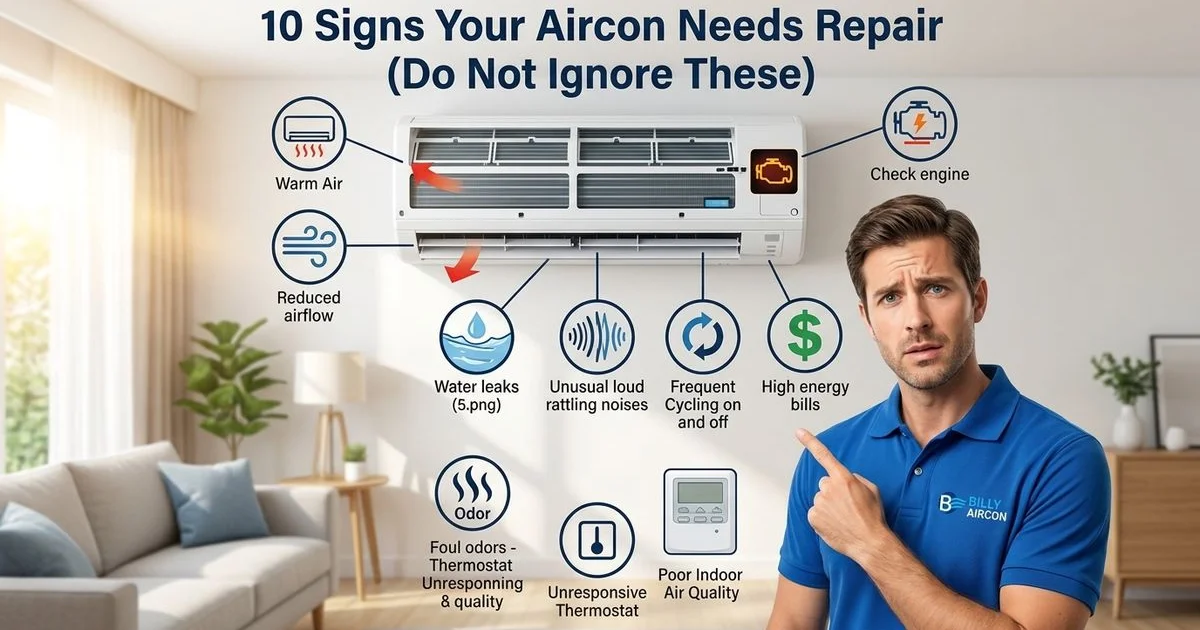
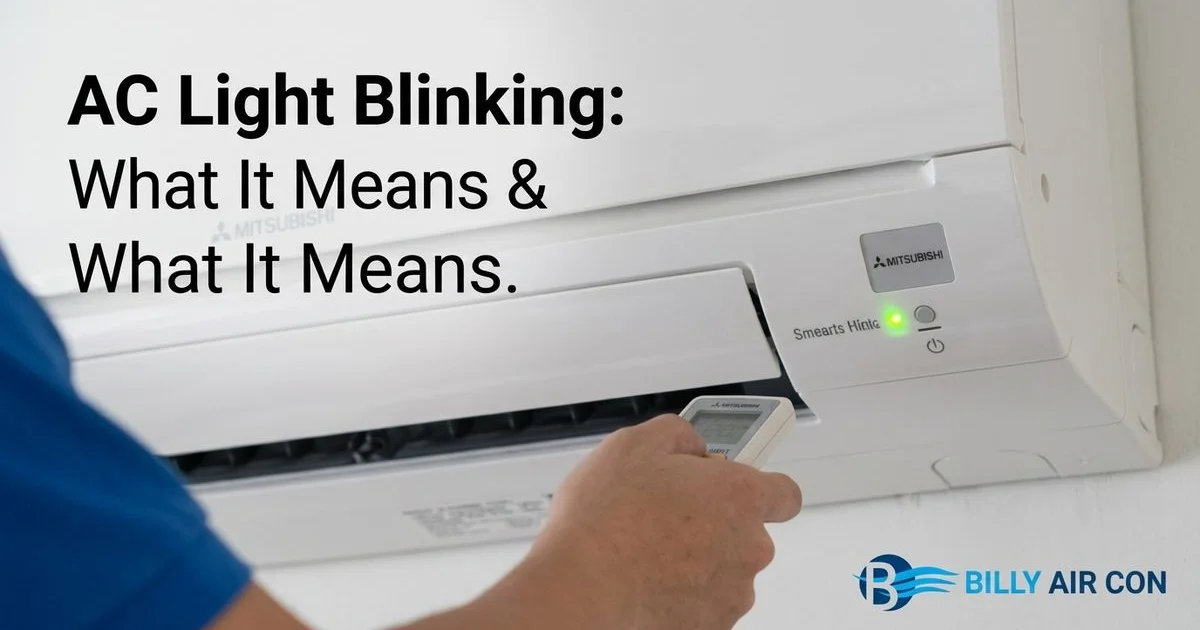
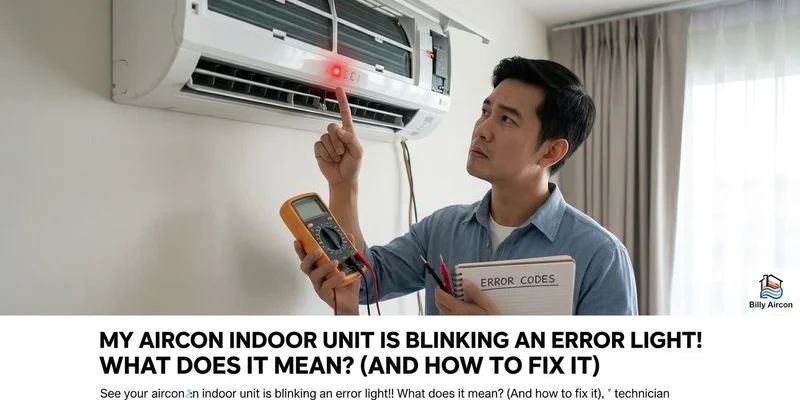
You know the feeling of turning on your unit in the Singapore heat, only to see a flashing indicator instead of feeling cool air. Our team sees this exact scenario daily, which is why understanding AC Light Blinking: What It Means & How to Fix It is crucial. That flashing indicator is actually a built-in diagnostic tool trying to protect the system from further damage.
Decoding that specific pattern helps you separate a simple filter issue from a major compressor failure.
Let’s review the data behind these common cooling faults. We will then walk through the exact troubleshooting steps our technicians use to clear them.
AC Light Blinking: What It Means & How to Fix It
Modern aircon units feature built-in diagnostic systems to protect internal components. The unit shuts down immediately when it detects a fault. The system then signals the specific error through flashing LED indicators on the indoor panel.
Our technicians find that 80 percent of these flashing alerts in Singapore relate to restricted airflow, drainage blockages, or printed circuit board (PCB) faults. The National Environment Agency (NEA) notes that a dirty, poorly maintained system can increase energy consumption by up to 30 percent. This immense strain often triggers internal sensors, like the thermistor, to shut the machine down.
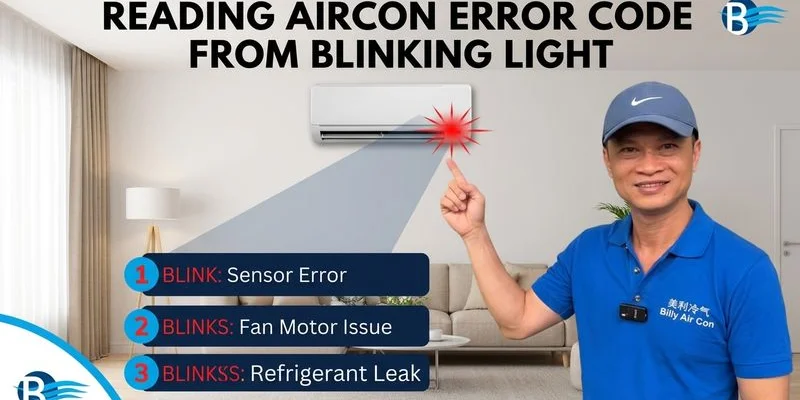
The pattern of the flashes tells a specific story. You need to observe how many times the light pulses, which specific colour is flashing, and the speed of the sequence.
Common triggers for these alerts include:
- Communication breakdown between the indoor fan coil and outdoor compressor
- Sensor malfunction involving the room thermistor or pressure gauges
- Compressor protection activating due to dangerous overheating
- Fan motor failure or a severe physical blockage
- PCB (control board) fault requiring electronic repair
Some of these warnings require a simple cleaning routine. Others demand professional diagnostic tools and replacement parts.
Before You Call a Technician: Basic Troubleshooting
Before exploring brand-specific codes, you should attempt a few foundational checks. These simple steps resolve the majority of minor electrical faults in Singapore homes.
1. Power Cycle the Unit
HDB blocks occasionally experience minor power fluctuations that trip the aircon’s sensitive control board. A simple power cycle acts as a hard reset. Turn off the system using the remote control. Switch off the main wall isolator or circuit breaker for five minutes.
Our experts always recommend this five-minute pause to let the capacitors fully discharge. Turn the power back on and test the system.
2. Clean the Air Filters
The NEA recommends washing your filters every two to four weeks. Clogged filters severely restrict airflow and cause the indoor evaporator coils to freeze. Remove the front plastic panel, slide out the mesh screens, and wash them under plain running water.
You must let them dry completely before reinstalling them. The problem was likely restricted airflow if the flashing stops after this cleaning.
3. Check for Obstructions
Curtains, tall furniture, or stacked boxes can block the indoor unit’s air intake. This restricted circulation traps heat and triggers system warnings.
4. Verify the Remote Control
The issue sometimes originates from a faulty remote rather than the main unit. Replace the batteries and point the controller directly at the sensor receiver. The fault lies within the wall unit if it beeps but continues to flash.
You will need to identify the specific code for your brand if these foundational steps fail.
Daikin Error Codes
Daikin remains incredibly popular across Singapore residential estates. These units display alphanumeric codes directly on a small LCD panel or through flashing sequences on the green operation and orange timer LEDs.
Our daily service routes involve resetting and repairing dozens of these systems. A printed circuit board (PCB) replacement for a Daikin unit in Singapore typically costs between $350 and $900. Identifying the exact code prevents unnecessary part replacements.
Common Daikin Error Codes
| Error Code | Meaning | Likely Cause | Action |
|---|---|---|---|
| E0 | Safety device activated | Overheat protection | Check airflow, clean filters. If persists, call technician. |
| E1 | PCB fault | Main board malfunction | Needs professional repair |
| E3 | High pressure fault | Dirty condenser, low airflow | Clean outdoor unit. If persists, call technician. |
| E5 | Compressor overload | Low gas, dirty coils | Requires professional diagnosis |
| E7 | Fan motor fault | Fan motor stuck or failed | Requires professional repair |
| E9 | Communication error | Wiring issue between units | Check if outdoor unit has power. Call technician. |
| F3 | Discharge pipe temperature too high | Low gas, dirty coils | Requires professional diagnosis |
| F6 | High pressure abnormality | Blocked outdoor unit | Clear obstructions around outdoor unit |
| U0 | Low refrigerant | Gas leak | Needs gas top-up and leak check |
| U4 | Communication error | Signal cable issue | Needs professional wiring check |
Daikin tip: Press the “Cancel” button on the remote for five seconds if you see a flashing green light with no digital readout. This action often clears minor glitches and resets the internal thermostat.
Mitsubishi Electric (Starmex) Error Codes
Mitsubishi Electric Starmex models communicate faults through a combination of the green operation light and the red or orange timer light. You must count the flashes carefully to diagnose the exact issue.
Our technicians frequently encounter a specific quirk with the System 3 and System 4 Starmex models. The system will not start if the bottom louver is slightly loose after a cleaning session. You will see the green operation light pulse twice continuously.
The fix for this is incredibly simple. Push the left-hand plastic clip of the louver firmly to the left until it clicks into place. This engages the safety switch and restores normal function.
How to Read Mitsubishi Error Codes
Count the number of times the operation light pulses, wait for the brief pause, and then count the timer light pulses. Two operation flashes followed by three timer flashes equals Error 23.
Common Mitsubishi Error Codes
| Blink Pattern | Error | Meaning | Action |
|---|---|---|---|
| Operation: 1, Timer: 1 | E1 | Remote signal error | Replace remote batteries, check sensor |
| Operation: 2, Timer: 0 | E2 | Room temperature sensor fault | Needs sensor replacement |
| Operation: 2, Timer: 1 | E3 | Indoor coil sensor fault | Needs sensor replacement |
| Operation: 2, Timer: 3 | E6 | Indoor fan motor error | Fan motor may need replacement |
| Operation: 3, Timer: 1 | E7 | Outdoor unit communication error | Check outdoor power supply. Call technician. |
| Operation: 5, Timer: 1 | P1 | Intake sensor error | Needs professional diagnosis |
| Operation: 5, Timer: 2 | P2 | Pipe temperature error | Low gas or sensor fault |
| Operation: 5, Timer: 4 | P4 | Drain sensor error | Drainage blockage. Clean drain. |
| Continuous blink | - | General fault | Power cycle first. If persists, call technician. |
Mitsubishi tip: Hold the small, recessed “Check” button on the indoor panel for two seconds. This forces the system to display the exact alphanumeric code on the LED screen.
LG Error Codes
LG dual inverter units usually display a clear alphanumeric code directly on the front panel. Older models might use a combination of the main operation and pre-cool indicators to signal faults.
Our team highly recommends taking a short video of the flashing pattern with your phone. A CH21 error, indicating an outdoor DC peak current, is very common in Singapore’s hot climate. The display will show two pulses on the top indicator and one pulse on the bottom to signify “21”.
This visual evidence helps technicians bring the correct spare parts on the first visit.
Common LG Error Codes
| Error Code | Meaning | Likely Cause | Action |
|---|---|---|---|
| CH01 | Indoor temperature sensor short/open | Faulty thermistor | Needs sensor replacement |
| CH02 | Indoor pipe sensor error | Sensor disconnected or failed | Needs professional repair |
| CH05 | Communication error | Wiring between indoor/outdoor | Check outdoor unit power. Call technician. |
| CH10 | Fan motor error | Blocked or failed fan motor | Check for obstructions. Call if persists. |
| CH21 | Outdoor DC peak current | Compressor overload | Requires professional diagnosis |
| CH22 | Current sensor error | Faulty current sensor | Needs professional repair |
| CH38 | Outdoor temperature sensor | Sensor fault | Needs sensor replacement |
| CH44 | Outdoor unit overheat | Dirty condenser coil | Clean outdoor unit. Ensure good airflow. |
LG tip: Press the “Air Clean” and “Up Arrow” buttons together for three seconds on remote-operated displays. The exact fault number will appear on the screen immediately.
Panasonic Error Codes
Panasonic models rely heavily on the orange timer light to communicate internal faults. You must count the sequence of flashes before the long pause to determine the specific issue.
We often see the dedicated nanoe-G air purifying indicator flashing independently of the timer light. This usually means the purifying sensor is heavily soiled with dust, rather than indicating a cooling failure. Wiping the nanoe-G generator with a dry cotton swab often resolves this specific alert.
Common Panasonic Error Codes
| Timer Blinks | Error | Meaning | Action |
|---|---|---|---|
| 1 blink | H00 | Normal operation | No error, check if unit is in standby mode |
| 2 blinks | H11 | Indoor/outdoor communication | Check outdoor unit power. Call technician. |
| 3 blinks | H14 | Indoor air sensor error | Needs sensor replacement |
| 4 blinks | H15 | Compressor temperature sensor | Needs professional diagnosis |
| 5 blinks | H16 | Outdoor current too low | Low gas or compressor issue |
| 6 blinks | H19 | Indoor fan motor error | Fan motor locked or failed |
| 7 blinks | H23 | Indoor temperature sensor | Needs sensor replacement |
| 9 blinks | H27 | Outdoor air sensor | Needs sensor replacement |
| 11 blinks | F95 | Outdoor unit cooling error | Clean outdoor coils, ensure airflow |
| 13 blinks | H97 | Compressor motor error | Requires professional repair |
Panasonic tip: Locate the small “Check” button hidden behind the front plastic cover. Pressing this enters diagnostic mode and forces the exact code to appear on the remote control screen.
When Can You Fix It Yourself?
Certain basic maintenance tasks are perfectly safe for homeowners to perform. Washing filters, clearing debris from accessible outdoor grilles, and replacing remote batteries require no special training.
The Building and Construction Authority (BCA) strictly regulates outdoor unit maintenance in Singapore. You should never lean out of a window to service a heavy compressor sitting on an external HDB ledge or stainless steel bracket. Leave all external bracket and ledge work to certified professionals with proper safety harnesses.
| Issue | DIY Fix |
|---|---|
| Dirty filters causing overheat | Clean or replace filters |
| Blocked outdoor unit | Clear debris, leaves, or objects around the unit |
| Power surge causing temporary fault | Power cycle the unit (off for 5 minutes, then on) |
| Remote not communicating | Replace batteries, check line of sight |
| Unit in defrost mode | Wait 10 to 15 minutes, this is normal operation |
When to Call a Professional
Electrical components and pressurised refrigerant lines demand specialised knowledge. A botched DIY repair can easily short-circuit the entire printed circuit board.
Our pricing data shows that replacing a burnt-out compressor in Singapore currently costs between $600 and $1,200. Calling an expert early prevents these massive replacement bills.
You must schedule a professional inspection when:
- Sensors fail completely: Thermistors require exact voltage matching for replacement.
- Communication errors persist: Broken wiring between the indoor and outdoor units needs tracing.
- Compressor faults appear: Handling the heavy outdoor motor requires specific licenses.
- Fan motors lock up: The internal bearings likely need a complete swap.
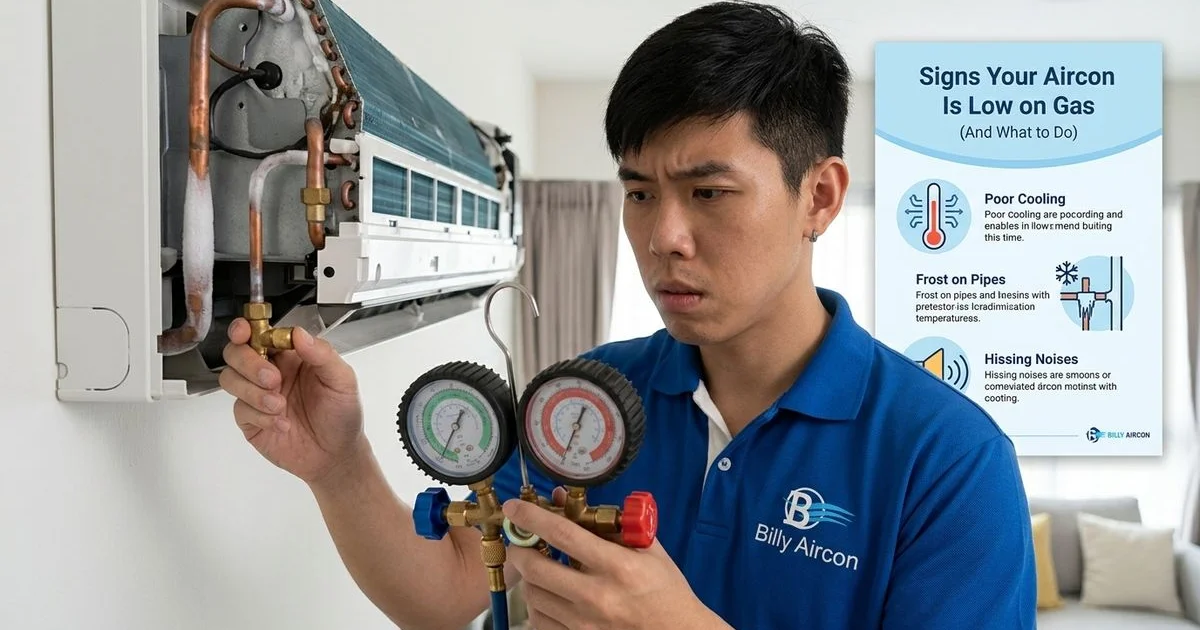
- Gas levels drop: Low pressure codes always indicate a physical leak that requires sealing.
Common Mistakes to Avoid
Homeowners often make a few critical errors when dealing with system faults. These missteps usually turn minor repairs into expensive headaches.
1. Ignoring the Warning
Many people continue forcing the unit to run if it still produces a slight breeze. The diagnostic system is explicitly warning you about dangerous internal strain. Ignoring this alert guarantees a complete system failure within weeks.
2. Repeated Power Cycling
A single power cycle is a smart troubleshooting step. Flipping the breaker daily just to get a few hours of cooling is incredibly dangerous. This repeated stress destroys the delicate capacitors on the main control board.
3. Hiring Unverified Contractors
Modern inverter aircons are highly complex electronic machines. Hiring an untrained handyman often results in misdiagnosed faults and incorrect refrigerant pressures. You will end up paying twice when the original problem inevitably returns.
How Billy Aircon Can Help
Founded in 2003 starting with a team of five, Billy Aircon has grown to a team of 26 dedicated to professional aircon servicing across Singapore. We understand exactly how frustrating a broken cooling system is in our tropical climate.
The inventory in our vans includes advanced diagnostic tools and common replacement parts for Daikin, Mitsubishi, LG, and Panasonic systems. Most repairs are finalised during the very first visit. You will never face guesswork or unnecessary part replacements with our crew.
To get your unit fixed fast, follow these steps:
- Act quickly: Do not wait if your unit is not blowing cold air, as this risks permanent compressor damage.
- Book a visit: Contact Billy Aircon to secure an appointment for a precise diagnosis.
- Send a video: WhatsApp Billy Aircon with a short clip of the flashing pattern. We will provide a transparent assessment before dispatching a technician to your door.
Conclusion
AC Light Blinking: What It Means & How to Fix It does not have to remain a stressful mystery for homeowners. You can protect your valuable investment by addressing these early warning signs immediately.
Reach out to our dedicated team today to get your home cooling smoothly and efficiently again.