We know that selecting the right cooling system is one of the biggest investments for your Singapore property.
With SP Group electricity tariffs sitting at 29.11 cents per kWh including GST in early 2026, making the wrong choice quickly becomes expensive . Our team at Billy Aircon has been providing reliable aircon servicing in Singapore since 2003, growing from a team of five to 26 dedicated experts.
This guide outlines exactly what you need to know. We will explain BTU sizing, the latest 2026 energy regulations, and which brands survive our climate best. Making an informed choice now secures comfortable, cost-effective cooling for the next decade.
Step 1: Determine the Right BTU for Your Room
We always start the assessment by calculating the exact British Thermal Unit (BTU) requirement for a space. The BTU figure simply measures the cooling capacity of the unit. Our experience shows that oversized units waste electricity, while undersized ones struggle to maintain a comfortable temperature.
BTU Guide for Singapore Homes
| Room Size (sq ft) | Recommended BTU | Typical Room |
|---|---|---|
| 100 - 150 | 9,000 | Small bedroom |
| 150 - 250 | 12,000 | Master bedroom |
| 250 - 350 | 18,000 | Living room (3-room HDB) |
| 350 - 500 | 24,000 | Living room (4-5 room HDB) |
| 500+ | 28,000 - 36,000 | Large living/dining (condo) |
Factors That Increase BTU Requirements
We recommend adding 10 to 20 percent more cooling capacity for specific layouts. Singapore’s intense afternoon sun changes the standard calculation. Our technicians frequently see clients make the mistake of buying the lowest-BTU unit for a large room. It runs constantly at maximum power and burns through electricity while delivering mediocre cooling.
- The room faces west: Afternoon sun heats up west-facing rooms significantly.
- High floor with direct sun exposure: Top floor units in HDB blocks absorb intense heat through the ceiling.
- Large windows without curtains or blinds: More heat enters through untreated glass panes.
- The room has heat-generating appliances: Kitchens adjacent to living rooms or setups with multiple computers generate extra heat.
- High ceilings: Condos with three-metre or higher ceilings require more cooling volume.
- Many occupants: Each person generates ambient body heat.
Step 2: Inverter vs Non-Inverter
We often field questions about the difference between these two technologies. The regulatory landscape in Singapore has made this decision much simpler. Our customers need to know that the National Environment Agency updated its Minimum Energy Performance Standards (MEPS) in April 2025 . This mandate requires all new multi-split systems to meet a strict five-tick rating, which relies entirely on advanced inverter technology .
Non-Inverter Aircon
A non-inverter unit uses a basic on and off mechanism. We explain this to clients as a car driving constantly at full throttle or stopping completely. The compressor runs at maximum capacity until the room reaches the set temperature, then it shuts off. Our data shows this constant starting and stopping creates massive stress on the compressor.
Pros:
- Lower initial purchase price for old single-split units.
- Simpler internal mechanics with fewer printed circuit boards.
Cons:
- Significantly higher electricity consumption.
- Noticeable temperature fluctuations as the unit cycles on and off.
- Louder operation during the full-power startup phase.
- Shorter overall lifespan.
Inverter Aircon
An inverter system adjusts the compressor speed continuously based on the exact room temperature. We prefer installing these units because they ramp up to cool the room quickly before slowing down to maintain the temperature. This modern technology runs on the new R32 refrigerant, offering superior efficiency over the phased-out R410A . Our tracking indicates a 30 to 50 percent drop in electricity consumption compared to older models.
Pros:
- Massive electricity savings over the unit’s lifespan.
- Consistent room temperature without hot and cold spikes.
- Quieter operation since the motor runs at lower speeds most of the time.
- Longer compressor lifespan due to reduced mechanical stress.
Cons:
- Higher upfront purchase price.
- More complex electronic components requiring specialized repairs.
Our Recommendation
We strongly advise homeowners to select an inverter model. The electricity savings easily cover the higher upfront cost within two to three years. Our team only suggests a non-inverter for a rarely used spare room that runs for less than an hour a day.
Step 3: System Type — Multi-Split vs Individual Units
Multi-Split System
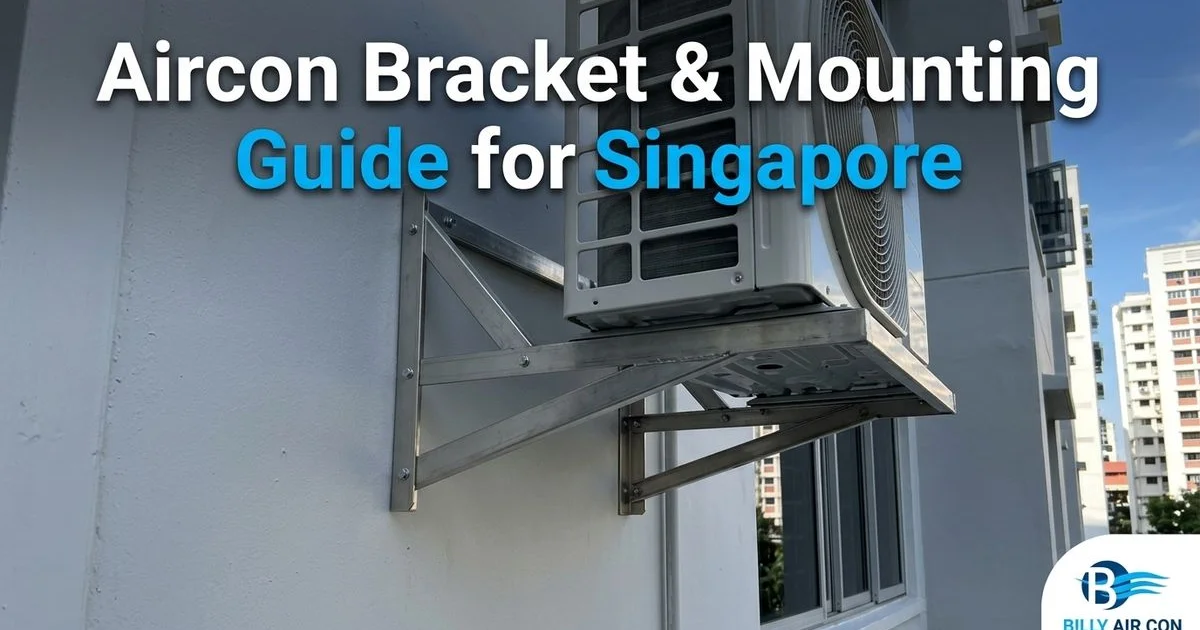
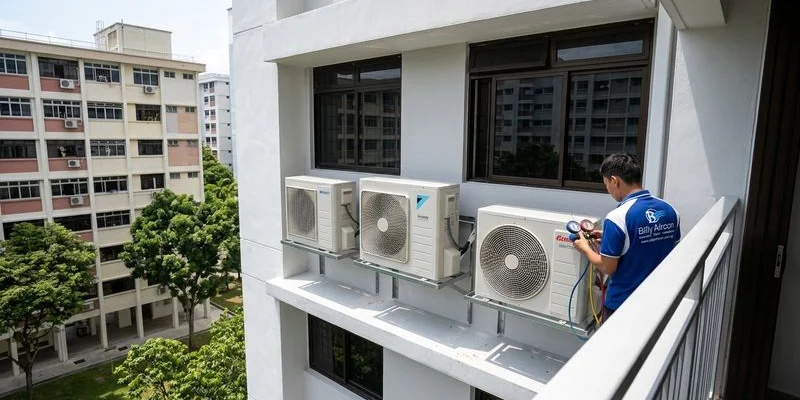
A multi-split setup uses one outdoor compressor unit to power several indoor units. We install this configuration most frequently in HDB flats and condominiums. HDB regulations strictly limit the aircon ledge weight to 110kg per wall panel . Our compliance checks ensure your system meets the maximum allowance of two split-type condensing units .
Typical configurations:
- System 2: One outdoor unit powering two indoor units (perfect for 3-room HDBs).
- System 3: One outdoor unit powering three indoor units (standard for 4-room HDBs).
- System 4: One outdoor unit powering four indoor units (ideal for 5-room HDBs and condos).
Pros:
- Requires only one outdoor unit, saving valuable ledge space.
- More cost-effective to install across multiple rooms.
- Presents a cleaner exterior appearance.
Cons:
- A compressor failure affects every connected indoor unit.
- Requires a higher initial investment.
Individual Split Units
Each room gets its own dedicated outdoor and indoor unit pair. We rarely see this in standard flats due to strict space and weight limitations. Landed properties and select older condominiums can accommodate this setup. Our main concern with individual units is the cluttered exterior appearance.
Pros:
- Independent operation means one failure does not affect the whole house.
- Easier to replace a single faulty unit.
Cons:
- Multiple outdoor units consume massive amounts of exterior space.
- Higher total cost for multiple separate installations.
Step 4: Choose the Right Brand
We consistently recommend two top-tier brands for Singapore’s intense humidity. These manufacturers invest heavily in specific features for tropical climates.
Tier 1: Premium Brands
Daikin
- Our top pick for smart home integration is the Daikin iSmileEco series .
- It operates on the eco-friendly R32 refrigerant .
- Users can control the system remotely using the Dsmart mobile application .
- Excellent energy efficiency with full five-tick options.
Mitsubishi Electric
- We highly praise the Mitsubishi Electric Starmex series for bedrooms.
- It operates at an incredibly quiet 19 decibels, ensuring undisturbed sleep .
- The proprietary Dual Barrier Coating prevents dust from sticking to internal components .
- Strong cooling performance even during peak afternoon heat.
Tier 2: Value Brands
These brands offer a solid middle ground for budget-conscious buyers. Our installations of these units show great reliability.
Panasonic
- This reliable Japanese brand features the popular nanoe-G air purification technology.
- We like the balance of cooling performance and reasonable pricing.
- They provide a wide range of models to fit various room sizes.
LG
- This Korean manufacturer utilizes strong dual inverter technology.
- Our technicians appreciate the modern designs and smart home compatibility.
- They deliver noticeable energy savings over older legacy systems.
Tier 3: Budget Brands
Sometimes a strict budget dictates the choice. We only recommend these for rental properties or temporary setups.
Midea
- This Chinese brand offers decent performance at a lower price point.
- Our teams find it easy to dismantle and maintain .
- Suitable for buyers needing immediate, basic cooling.
EuropAce
- This local brand provides very affordable entry-level options.
- We warn clients that long-term running costs might be higher.
- Adequate for occasional, short-term usage.
Step 5: Energy Efficiency — NEA Tick Rating
Singapore uses the National Environment Agency (NEA) tick system to rate energy efficiency. We want to highlight a massive regulatory shift that occurred in April 2025. The government raised the Minimum Energy Performance Standards (MEPS) for all new sales . Our clients must now choose five-tick models for any new multi-split system installation .
| Tick Rating | Annual Electricity Savings vs 1-Tick |
|---|---|
| 1 tick | Baseline |
| 2 ticks | ~10% savings |
| 3 ticks | ~20% savings |
| 4 ticks | ~30% savings |
| 5 ticks | ~40% savings |
A five-tick system costs more upfront, but the savings are undeniable. We calculate that a five-tick model saves roughly $170 to $260 annually compared to an older three-tick unit .
The Singapore government is also helping offset this initial cost in 2026. Our customers can claim a $400 Climate Voucher to use exclusively on eligible five-tick systems .
This voucher effectively wipes out the price difference between less efficient legacy models and modern units .
Step 6: Features Worth Paying For
Must-Have Features
We prioritize features that directly impact health and operating costs. Certain functions are critical for surviving the high humidity.
- Self-cleaning function: The unit dries the evaporator coils after operation to prevent mould growth.
- Timer function: Set the system to turn off automatically during the cooler early morning hours.
- Sleep mode: Gradually increases the temperature during the night for comfort and energy savings.
- Turbo mode: Quickly drops the room temperature when you first arrive home.
Nice-to-Have Features
Other features offer great convenience but are not strictly essential. Our team loves setting up smart controls for tech-savvy clients.
- Wi-Fi control: Applications like Daikin’s Dsmart let you turn the unit on before reaching your door .
- Air purification: High-end models feature PM2.5 filters to trap microscopic haze particles and allergens .
- Motion sensor: Adjusts the fan speed based on room occupancy.
- Quiet mode: Drops the fan noise down to 19 decibels for light sleepers .
Features You Can Skip
Some additions simply inflate the price without improving the core cooling function. We advise against paying extra for pure aesthetics.
- Fancy LED displays: They look modern but do not enhance the actual air distribution.
- Excessive design elements: Focus on the internal compressor quality instead of the plastic casing.
- Overly complex smart features: More complex circuit boards mean more potential points of failure.
Installation Matters as Much as the Unit
Even the most expensive five-tick unit will perform poorly if installed incorrectly. We see countless systems fail prematurely due to rushed, subpar pipework. The Housing & Development Board requires all installations to be performed by BCA-trained technicians . Our team ensures every single connection meets these strict safety standards.
Here is what to look for in a quality installation:
- Proper trunking: Neat, secure, and correctly sized insulation pipes prevent condensation.
- Correct drainage slope: A proper angle ensures water flows out easily, preventing indoor leaks.
- Adequate copper piping length: Too long reduces efficiency, while too short limits placement options.
- Secure wall mounting: The indoor unit must be firmly attached and perfectly level.
- Proper electrical wiring: A dedicated 15-amp or 20-amp circuit prevents power trips .
We strongly advise against hiring an unlicensed contractor just to save a few dollars. Cheap workmanship inevitably leads to water leaks, poor cooling performance, and dangerous electrical hazards.
Common Mistakes to Avoid
Avoiding these frequent errors will save you thousands of dollars over the next decade. Our technicians respond to repair calls daily because of these easily avoidable oversights.
- Choosing based on price alone: The cheapest unit will cost you double in electricity and repair bills over its lifetime.
- Ignoring BTU requirements: Undersized units waste power and deliver terrible air circulation.
- Skipping inverter technology: Inverter systems are now a legal standard for multi-splits because of their massive efficiency .
- Choosing an unknown brand: Finding replacement parts for obscure brands becomes impossible after three years.
- Hiring the cheapest installer: Substandard insulation and poor pipe joint flaring guarantee future water leaks.
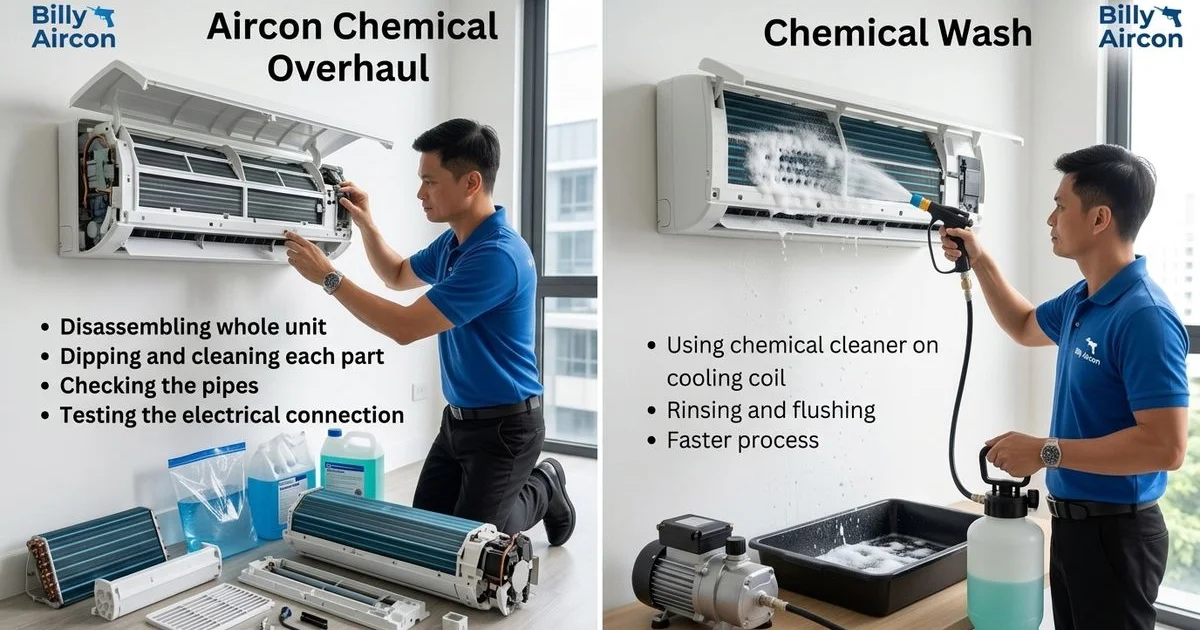
- Forgetting about maintenance: Regular chemical washes and filter cleanings are essential for tropical climates.
Ready to Install a New Aircon?
Selecting the right cooling system is a major commitment for any property. We are here to ensure you get the absolute best performance for your budget.
The experienced crew at Billy Aircon helps homeowners select, install, and maintain equipment that delivers years of reliable comfort. Our technicians provide transparent pricing and professional execution from start to finish.
Reach out via WhatsApp Billy Aircon to discuss your specific floor plan. We will recommend the exact specifications required for your room sizes and usage patterns.