You know how frustrating it is when your cooling system suddenly stops blowing cold air right in the middle of a sweltering afternoon. An aircon gas leak is often the hidden culprit behind this sudden drop in performance.
Unlike a basic dirty filter or a blocked drain, losing refrigerant directly impacts your electricity consumption and can even pose minor health risks.
Most property owners only notice the warning signs when the system completely breaks down. We see this specific issue weekly across Singapore. To help you resolve this problem, we compiled this definitive guide covering an aircon gas leak: signs, dangers & what to do, so you can protect your property and lower your electricity bills.
What Is Aircon Gas?
When people refer to “aircon gas,” they mean refrigerant. This chemical compound cycles constantly through your air conditioning system to absorb heat from the indoor air and release it outside. Without sufficient refrigerant, your unit simply cannot cool the room.
Our team of 26 technicians has observed directly how environmental regulations are changing the types of gases used. By 2026, the National Environment Agency (NEA) has mandated a complete shift to R32 for all new single-split air conditioners in Singapore.
This is a massive shift for the industry, primarily because R32 has a Global Warming Potential (GWP) that is 67% lower than the older R410A standard.
| Refrigerant | Common Name | Status | Typical Use |
|---|---|---|---|
| R22 | Freon | Banned for new units (ozone-depleting) | Older units (pre-2015) |
| R410A | Puron | Being phased out | Most systems installed 2010-2023 |
| R32 | - | Current NEA mandated standard | Modern split systems (lower GWP) |
Refrigerant operates in a completely sealed system. It should never need topping up under normal conditions. If your unit is low on gas, there is a physical hole or crack somewhere in the copper piping.
7 Signs of an Aircon Gas Leak
1. Aircon Is Running but Not Cold
This is the most common and earliest indicator of trouble. Your unit turns on, the fan blows at full speed, but the air coming out feels warm or only slightly cool.
We often measure the “Delta T” (the temperature difference between the return air and supply air), which should ideally sit around 8 to 10 degrees Celsius. A leaking unit will barely manage a 2-degree drop.
Many property owners mistakenly assume the system just needs a basic cleaning. If washing the filters and clearing the dust does not improve the cooling performance, low refrigerant is very likely the root cause.
2. Ice or Frost on the Refrigerant Pipes
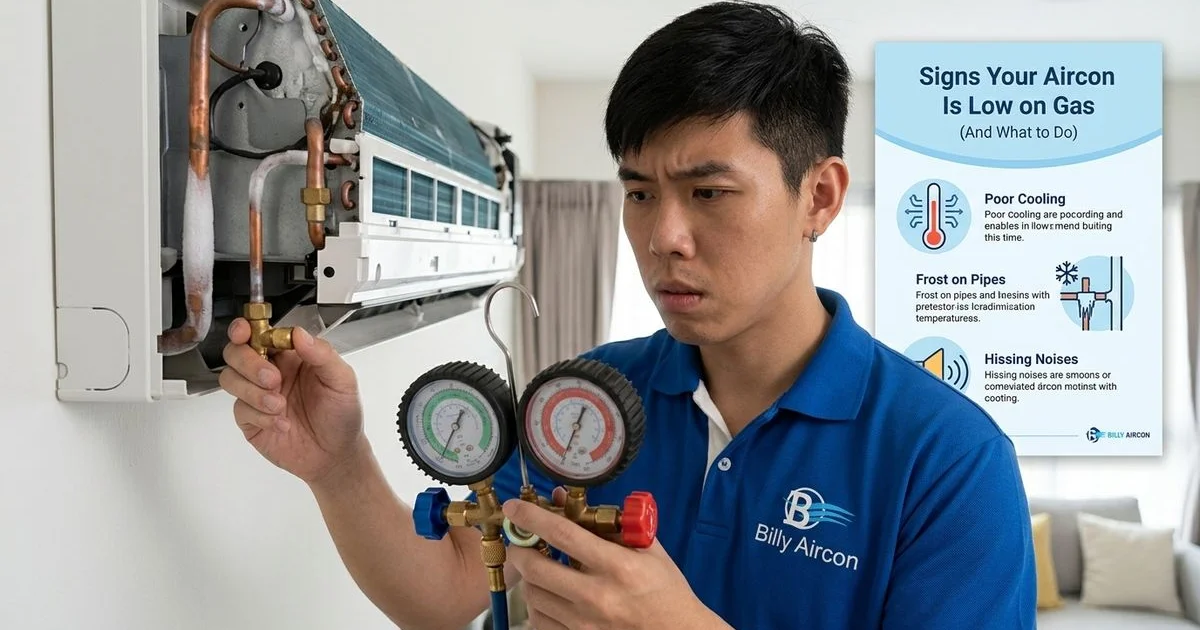
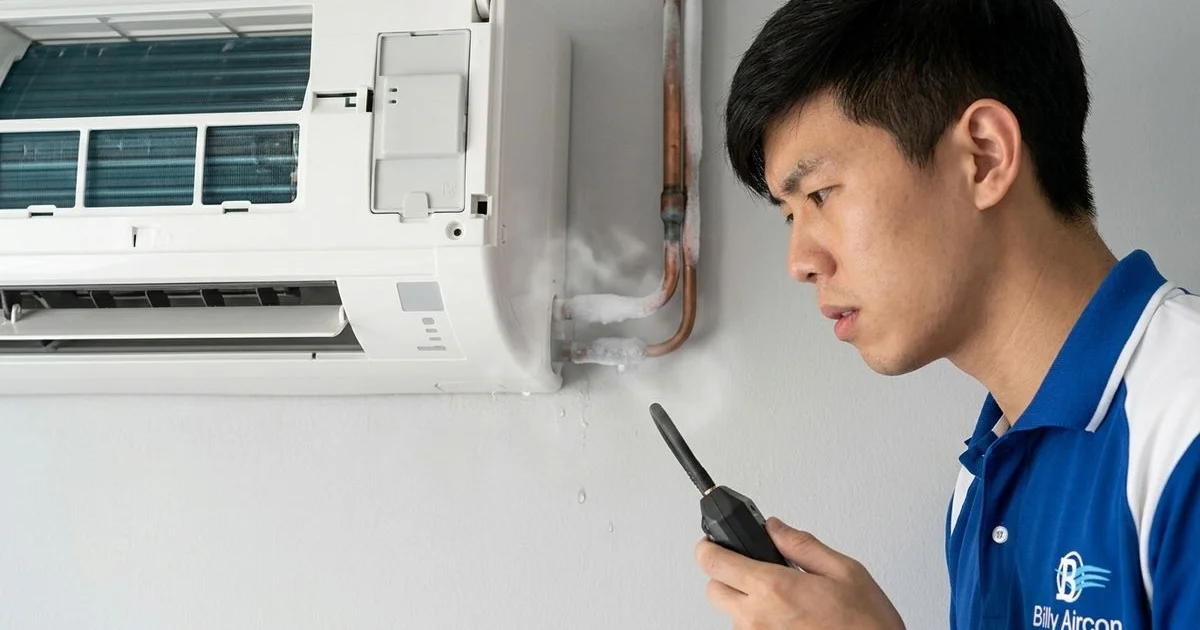
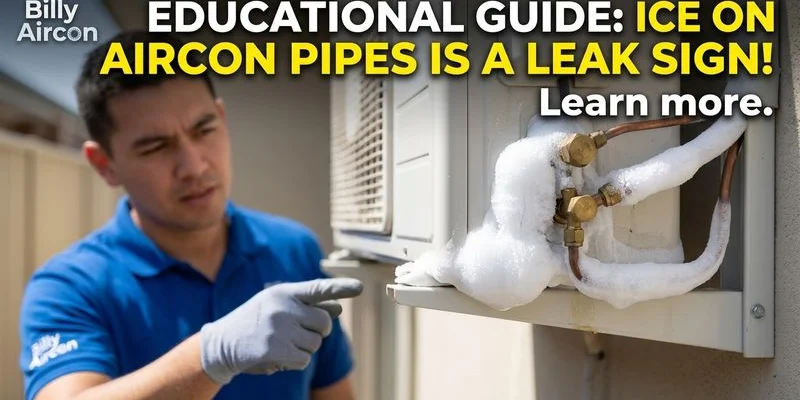
Look closely at the copper pipes connecting your indoor and outdoor units. If you see white ice or frost forming on the thinner liquid line, this is a glaring red flag for low gas.
When refrigerant levels drop, the remaining chemical expands too rapidly in the evaporator coils, causing the coil temperature to plummet below freezing.
This leads to a rapid chain reaction:
- The chilled copper reaches sub-zero temperatures.
- Singapore’s average 84% relative humidity hits the cold metal.
- The airborne moisture instantly freezes into a thick layer of white frost.
3. Hissing or Bubbling Sounds
A distinct hissing sound coming from the indoor fancoil or outdoor condenser often indicates high-pressure gas escaping through a tiny crack. Bubbling noises usually suggest a leak in a section where the refrigerant is still in its liquid state.
These sounds are incredibly faint. You will need to listen carefully when the room is completely quiet to catch them.
The hissing is usually most noticeable right near the flare joints, which are the connection points between the indoor and outdoor units.
4. Higher Electricity Bills
When gas levels drop, the compressor works much harder and runs longer to try to hit your desired room temperature. This increased workload translates directly into a spike in electricity consumption.
For the first quarter of 2026, the SP Group electricity tariff sits at 29.11 cents per kWh with GST. To understand the financial impact, consider these figures:
- A healthy compressor cycles off regularly to save power.
- An overworked, leaking unit runs continuously at maximum electrical draw.
- This constant operation can easily inflate your monthly utility bill by 20% to 30%.
If your SP bill has jumped significantly without any change in your daily usage patterns, a leaking copper pipe could be the financial drain.
5. The Compressor Runs Continuously
Under normal conditions, an inverter compressor will ramp down its speed once the room reaches the set temperature. With a gas shortage, the system cannot bring the temperature down, so it runs at 100% capacity non-stop.
We frequently see this continuous operation burn out compressors years before their expected lifespan. Running a compressor dry causes massive internal friction and wastes a huge amount of electricity.
6. Water Leaking from the Indoor Unit
The ice formation on your evaporator coils eventually melts when you turn the unit off. This rapid melting produces far more water than the standard 16mm PVC drainage pipes in most HDB flats can handle.
This sudden flood of excess water overflows the internal drainage pan, leading to several messy consequences:
- Water drips directly down your freshly painted walls.
- Laminate flooring beneath the fancoil can warp and buckle.
- Hidden mould begins to grow behind the plastic casing.
If you have water dripping combined with weak airflow and frosted pipes, a refrigerant shortage is almost certainly the culprit.
7. An Unusual Chemical Smell
In some rare cases, a severe leak produces a faint, sweet, ether-like smell near the indoor fancoil. This is not always present because modern R32 and R410A refrigerants are mostly odourless.
You might only notice the scent if you place your nose right next to the air outlet. If you do detect an unusual chemical scent in your bedroom that was not there yesterday, you need to investigate it immediately.
Health Risks of Aircon Gas Leaks
Modern A2L refrigerants like R32 are generally considered low-toxicity, but they are certainly not harmless. Here is exactly what you need to know about the health implications.
In a Well-Ventilated Room
For most standard household leaks, the amount of gas escaping is tiny and disperses rapidly. The health risk remains extremely minimal in a well-ventilated space.
You would need the gas concentration to exceed 400 parts per million (ppm) to feel significant physical symptoms. You might notice a slight headache if you sit directly under the leaking fancoil for hours.
In an Enclosed Room
The risks increase slightly if the leak is massive and happens inside a poorly ventilated space. A typical HDB master bedroom measures around 11 to 15 square metres, meaning a sudden, large-scale leak could theoretically concentrate the gas.
Here are the specific symptoms to watch for:
- Oxygen displacement: Massive amounts of gas can push oxygen out of a small, sealed room, causing slight breathing difficulties.
- Dizziness and headaches: Inhaling concentrated chemical vapours often triggers sharp headaches.
- Nausea: Certain individuals experience strong nausea when exposed to raw refrigerant.
- Skin and eye irritation: Direct physical contact with pressurized liquid refrigerant causes severe frostbite burns.
Special Concerns
- R32 refrigerant carries an A2L classification, meaning it is mildly flammable. The risk of ignition in a standard home is incredibly low, but you should absolutely never use open flames or smoke near a suspected leak.
- R22 refrigerant breaks down into highly toxic compounds if exposed to a direct flame or extreme heat.
Practical Advice
For a typical residential leak in Singapore, follow these practical steps:
- Open all your windows and bedroom doors to ventilate the space instantly.
- Turn off the air conditioner at the main isolator switch.
- Keep calm, as the gas volumes in single-split units are generally quite small.
- Call a certified technician to run a proper pressure test.
The actual health dangers are very low, but you should never sleep in a sealed bedroom with an actively leaking cooling system.
What Causes Gas Leaks?
Understanding the root causes helps you protect your investment and prevent future breakdowns.
Vibration and Wear
The constant 50Hz vibration from the outdoor compressor eventually loosens the mechanical connections. Over five to seven years, this shaking creates micro-cracks in the copper piping, especially at the flare nuts and joint connections.
We see this vibration damage most often in older condenser units mounted on aging metal brackets.
Corrosion
Corrosion is a massive problem in Singapore due to our salty coastal air and high humidity. A specific issue called formicary corrosion (often nicknamed “ant-nest corrosion”) accounts for roughly 10% of all early coil failures.
This hidden damage is triggered by everyday items releasing volatile organic compounds (VOCs) into your home:
- Household cleaning sprays and disinfectants.
- Aerosol air fresheners and strong perfumes.
- Off-gassing from new plywood furniture.
These chemicals react with the moisture on your copper coils, eating microscopic, pinhole tunnels through the metal from the inside out.
Poor Installation
Improperly flared copper connections, loose fittings, and poorly brazed joints are the most frequent causes of rapid gas loss in newly installed systems.
Using sub-standard materials also accelerates the rusting process. A cheap installation usually guarantees expensive repair bills within the first two years.
Physical Damage
Accidental physical impacts to the outdoor condenser or the insulated pipes easily cause immediate ruptures.
During home renovations in BTO flats, contractors sometimes accidentally damage the concealed copper pipes running above the false ceiling by:
- Drilling too close to the insulated trunking.
- Bending the copper lines to fit new light fixtures.
- Dropping heavy tools directly onto the delicate condenser fins.
This physical stress weakens the metal and eventually splits it open.
Factory Defects
Occasionally, a pure manufacturing defect in the evaporator u-bends will cause a slow leak. This microscopic flaw usually reveals itself within the first eight to twelve months of daily use and is fully covered under the brand’s warranty.
Aircon Gas Leak: Signs, Dangers & What to Do During an Emergency
Step 1: Turn Off the Aircon
Stop using the machine immediately. Continuing to operate a system with low gas puts immense strain on the internal motor.
The compressor is engineered to pump gas, not run completely dry. Forcing it to operate without enough refrigerant will permanently burn out the motor. A full compressor replacement in Singapore currently costs between $600 and $1,200, which is an incredibly painful bill to pay.
Step 2: Ventilate the Room
Open your windows wide to let any lingering A2L refrigerant vapours safely blow outside. This is a basic precautionary measure, as the total volume of gas in a home system is quite small.
Step 3: Call a Qualified Technician
Do not try to patch a high-pressure copper pipe with tape or sealant. Handling these chemicals requires proper certification, nitrogen tanks, and specialized brazing torches.
A licensed professional will execute the following process:
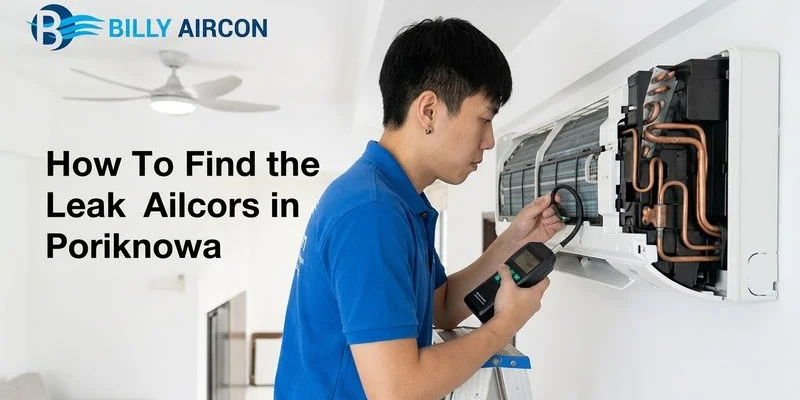
- Confirm the leak: Technicians use highly sensitive electronic sniffers (like Inficon detectors) or inject UV dye to spot the exact failure point.
- Locate the leak point: This involves checking every single flare nut, u-bend, and inch of copper piping.
- Repair the leak: The expert will braze the hole shut with a blowtorch, re-flare the bad connections, or replace the corroded section entirely.
- Vacuum the system: A specialized vacuum pump is used to suck out all the atmospheric air and moisture that contaminated the lines.
- Recharge the refrigerant: The exact required amount of R32 or R410A is weighed on a digital scale before being pumped into the system.
- Test the system: Finally, the unit is run at full blast while monitoring the manifold gauges to guarantee the pressures hold steady.
Step 4: Understand the Repair vs Replace Decision
If the hole is at an accessible flare joint, fixing it is straightforward and very affordable. If the microscopic pinholes are buried deep inside a severely rusted indoor evaporator coil, the repair costs often skyrocket.
Our team uses a strict “50% rule” to advise clients on the best financial move. If the repair quote exceeds half the price of a brand-new system, and your current machine is over eight years old, buying a new inverter unit makes far more economic sense.
Gas Top-Up: A Temporary Fix
Many budget service companies will offer you a quick gas top-up to get your room cold again today. While injecting fresh refrigerant works for a short time, it is a complete waste of money because it ignores the actual physical hole in your pipe.
We have seen temporary top-ups leak back out into the atmosphere in as little as two weeks to three months. A standard R32 refill in Singapore costs around $40 to $80 per kilogram, and paying that repeatedly adds up fast.
“A gas top-up without fixing the underlying pipe is exactly like pouring expensive bottled water into a bucket with a massive crack at the bottom.”
A permanent solution requires finding the hole, sealing it with a brazing torch, pressure testing the lines with nitrogen, and then pulling a deep vacuum before adding new gas.
Prevention: How to Minimise Gas Leak Risk
You cannot completely eliminate the risk of parts wearing out, but you can drastically extend the lifespan of your copper pipes.
- Regular servicing: Booking regular aircon servicing (usually costing $30 to $60) every quarter allows technicians to spot early corrosion or loose nuts before they fail.
- Quality installation: Always hire licensed installers who use thick, Class 0 Armaflex insulation and pressure-test their flare joints with nitrogen before leaving your home.
- Protect outdoor units: Keep the area around your condenser clear of heavy debris and ensure it is mounted on high-quality, vibration-dampening rubber pads.
- Address issues promptly: If you notice ice on the pipes or weak airflow, shut the system down immediately to protect your expensive compressor.
When to Call Billy Aircon
If your room feels warm, you spot white ice on the copper lines, or you hear a faint hissing sound, contact Billy Aircon immediately. Our team of 26 dedicated technicians carries advanced electronic leak detection tools and can pinpoint the exact fault within minutes.
Full transparency is standard practice here, so you will know straight away if a gas top-up makes sense for a minor issue or if you need a permanent brazing repair.
You get honest advice with absolutely zero high-pressure sales tactics. WhatsApp Billy Aircon today to schedule a thorough diagnostic check, because understanding an aircon gas leak: signs, dangers & what to do is our true specialty across every single neighbourhood in Singapore.