Many property managers and homeowners face a familiar frustration when the cooling suddenly drops. The unit hums along fine, but the room stays warm. This points to a specific issue with the refrigerant levels.
We started Billy Aircon in 2003 with just five technicians providing aircon servicing in Singapore. This small crew quickly expanded into a team of 26 dedicated cooling experts.
We have seen every type of failure across Singapore flats and commercial spaces over the years. The root cause is frequently misdiagnosed by standard handymen.
The truth is often a hidden refrigerant leak draining the system.
Let us look at the exact Signs Your Aircon Is Low on Gas (And What to Do) right now. You will learn how to spot the symptoms early, understand the different coolants, and find out the exact steps to fix the root cause.
How Your Aircon Uses Gas
Before checking for symptoms, you need to understand the basic mechanics. A split-system aircon relies on a continuous, sealed loop to transfer heat outside your HDB flat or office.
This process relies on four main stages:
- Evaporator (indoor unit): Liquid refrigerant absorbs heat from your room, turning into a vapour.
- Compressor (outdoor unit): The system squeezes this vapour, raising its pressure and heat.
- Condenser (outdoor unit): Hot vapour releases heat into the Singapore air, returning to a liquid state.
- Expansion valve: The liquid cools down rapidly before re-entering your room.
We often remind customers that this is a completely sealed circuit. Your unit never actually consumes the coolant during normal operation. A drop in pressure means a crack or faulty flare joint has allowed the chemical to escape.
6 Signs Your Aircon Is Low on Gas
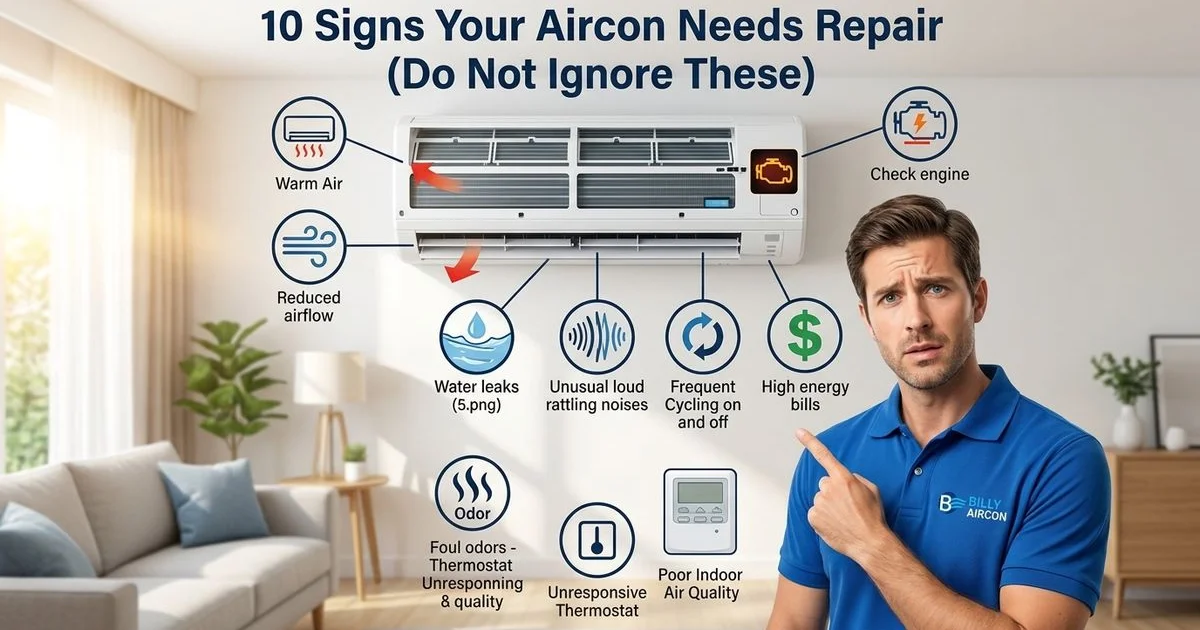
1. Warm Air Blowing from the Indoor Unit
This is usually the first red flag. You set your remote to a comfortable 23 degrees Celsius, but the room feels stuffy. The fan spins at full speed, yet the breeze feels basically like room temperature.
A healthy system in Singapore should output air that is roughly 10 to 12 degrees cooler than the room’s current temperature. A low coolant charge severely drops this capacity because there is not enough chemical in the evaporator coil to absorb the heat.
Pro Tip: Place a digital meat thermometer directly in front of the indoor blower vent. A reading above 16 degrees Celsius usually confirms the system is struggling to cool the air.
2. Ice or Frost on the Refrigerant Pipes
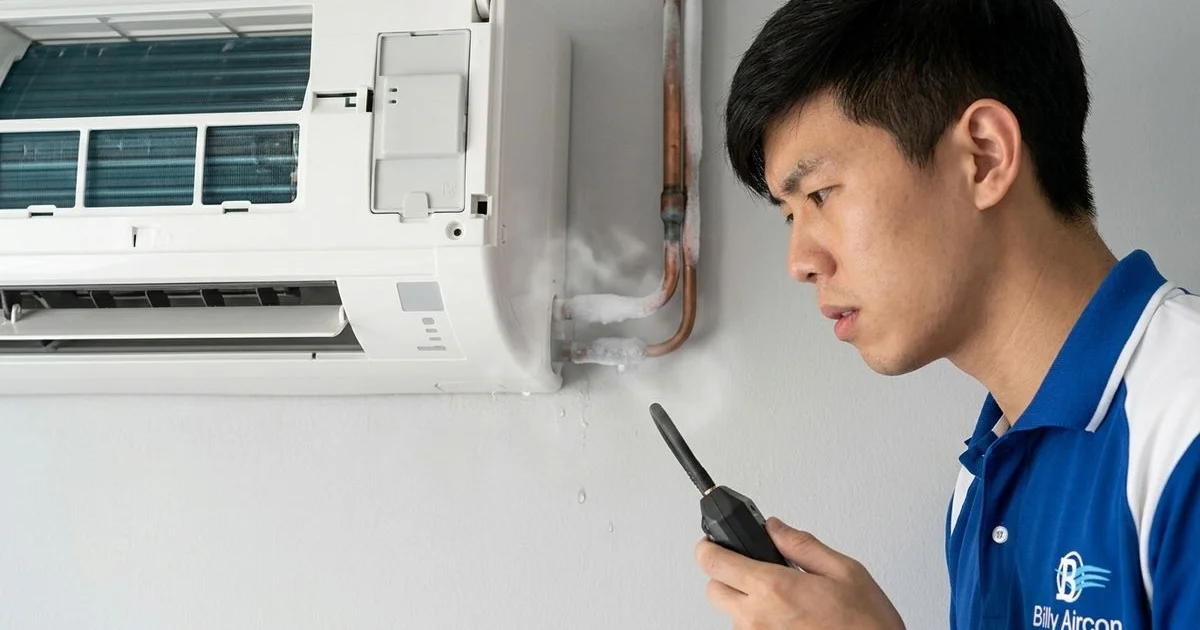
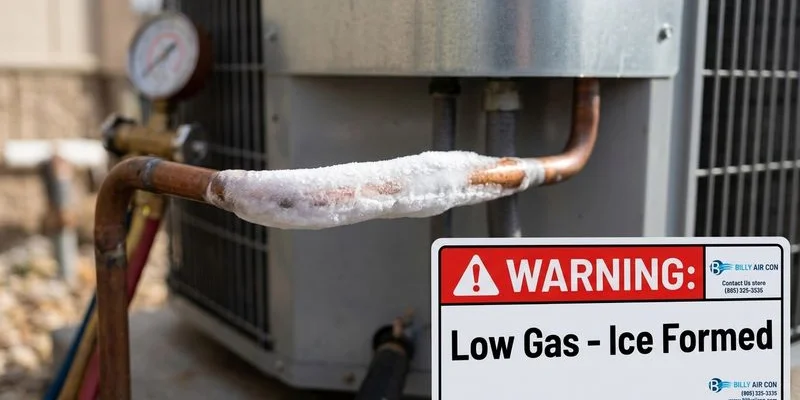
Look closely at the copper lines connecting your indoor fancoil to the outdoor condenser. You might spot a thick layer of white frost forming on the thinner pipe. This is a massive warning sign.
We regularly see this happen because escaping gas causes a severe pressure drop inside the system. The remaining fluid drops below freezing. The high humidity in Singapore then immediately condenses and freezes right onto the cold copper.
Important Safety Notice: Turn off the power immediately if you spot ice buildup and let it melt naturally. Trying to scrape this frost away will easily puncture the soft copper coils.
3. Hissing or Bubbling Sounds
A quiet room might reveal the exact location of the fault. Listen closely near the indoor fancoil or the outdoor compressor for two specific noises.
These sounds indicate different types of breaches:
- Hissing: High-pressure gas is shooting out from a tiny pinhole leak in the copper tubing.
- Bubbling: Air is entering the liquid line, or fluid is escaping from a larger crack.
Look for dark, greasy patches near the pipe joints while you listen. Refrigerant carries a special compressor oil. A leak almost always leaves a visible, sticky oil stain behind.
4. The Compressor Runs Without Stopping
Modern inverter units from brands like Daikin or Mitsubishi are designed to slow down once the room hits the target temperature. A compromised system never reaches that goal.
The outdoor unit will stay locked at maximum power indefinitely. This relentless workload creates several major problems for your equipment.
Continuous operation guarantees:
- A massive spike in your monthly utility bill.
- Severe mechanical wear on the internal motor.
- A high risk of thermal overload and complete failure.
5. Water Leaking from the Indoor Unit
A sudden indoor waterfall is a very messy secondary symptom. The ice buildup from symptom number two will eventually melt when you power down the system.
We often get emergency calls for flooded master bedrooms due to this exact sequence of events. The sheer volume of melting ice overwhelms the internal drainage pan.
The water bypasses the PVC drain pipe entirely. This overflow can cause severe damage to:
- Fresh wall paint and plaster.
- Expensive parquet flooring.
- Electronic devices situated below the fancoil.
6. Unusually High Electricity Bills
Your monthly utility statement provides hard data on your system’s health. A struggling compressor draws significantly more amperage to compensate for the missing coolant.
You might notice a sudden 20 to 30 percent spike in your power usage. This happens even if your daily running hours remain exactly the same.
Financial Impact: Based on current SP Group tariffs, a struggling compressor can easily add an extra $40 to $60 to your monthly bill. A prompt diagnostic check stops this financial drain.
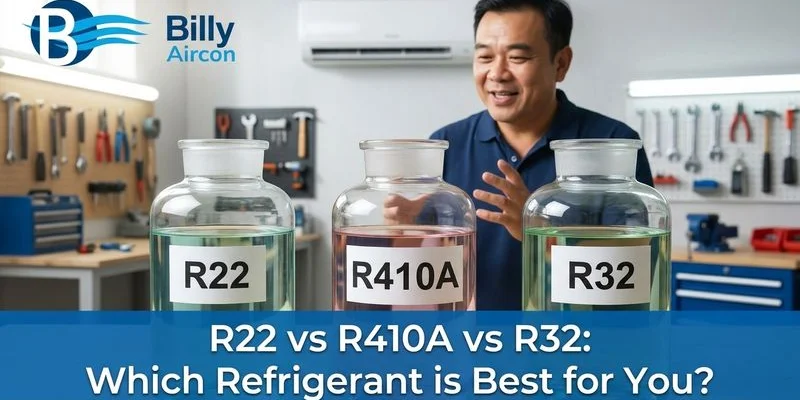
Understanding Refrigerant Types: R22 vs R410A vs R32
Different models require completely different chemical compounds. The specific variant dictates your system’s efficiency and the final price of any maintenance work.
R22 (Freon)
The National Environment Agency banned the import of new R22 equipment into Singapore over a decade ago. Existing supplies are dwindling rapidly.
| Aspect | Current Status in Singapore |
|---|---|
| Market Status | Nearing complete phase-out |
| Environmental Impact | High ozone depletion potential |
| Typical Units | Systems installed before 2015 |
| Maintenance Cost | Extremely high due to market scarcity |
We strongly advise against spending money to patch an old R22 system. The exorbitant cost of the chemical makes a full system upgrade a much smarter financial decision. You cannot just swap in a modern compound, as the old pipes cannot handle the pressure.
R410A (Puron)
This chemical became the standard replacement for residential setups throughout the 2010s. It eliminates the ozone threat entirely.
| Aspect | Current Status in Singapore |
|---|---|
| Market Status | Common but slowly being replaced |
| Environmental Impact | Zero ozone depletion, but high global warming potential |
| Typical Units | Most standard split-systems from 2010 to 2020 |
| Maintenance Cost | Standard market pricing |
R410A operates at a much higher pressure threshold than older variants. This requires thicker copper piping, typically 0.71mm (SWG 22) or thicker, to prevent dangerous ruptures.
R32
This is the undisputed modern standard for new installations across the island. Brands like Panasonic, Mitsubishi Electric, and LG exclusively use this highly efficient variant.
| Aspect | Current Status in Singapore |
|---|---|
| Market Status | The dominant industry standard |
| Environmental Impact | 67 percent lower global warming potential than R410A |
| Typical Units | All latest high-efficiency inverter models |
| Maintenance Cost | Standard, widely available |
R32 requires a smaller total volume to achieve the exact same cooling output. This translates directly to better energy efficiency ratings and lower running costs for your household.
What to Do If Your Aircon Is Low on Gas
Step 1: Stop Using the Aircon
Cut the power at the main isolator switch immediately. The compressor relies on the circulating coolant to transport essential lubricating oils.
Cost Warning: Running a dry system causes massive internal friction. A total compressor replacement costs between $600 and $1,200. This easily dwarfs the price of a simple leak repair.
Step 2: Call a Qualified Technician
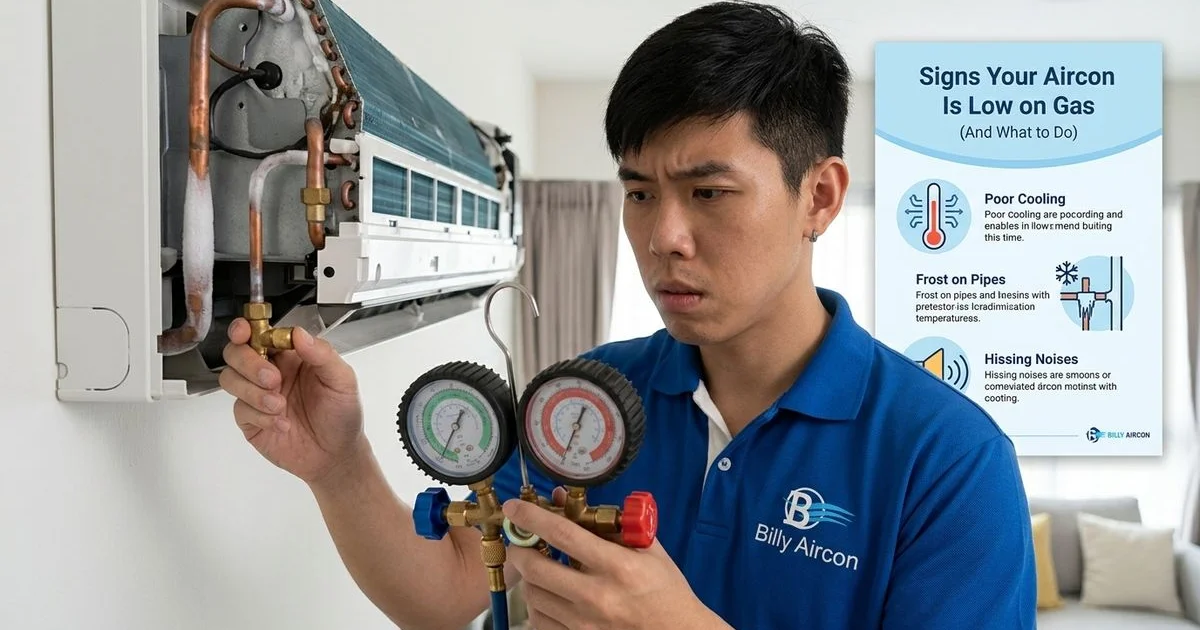
This is never a DIY project. Handling these volatile chemicals requires specific safety certifications and highly specialised tools.
A professional response team will arrive with:
- Digital manifold gauges to read exact internal pressures.
- Electronic sniffers to pinpoint micro-fractures.
- Heavy-duty vacuum pumps to clear the lines completely.
Step 3: Insist on Leak Detection
Do not let anyone simply pump fresh chemical into a compromised system. This is a temporary fix that guarantees another breakdown within weeks.
We ensure every gas top-up service follows a strict diagnostic protocol. A proper repair job must permanently fix the source of the issue.
A comprehensive service includes:
- Pressure test: Checking current levels with digital manifold gauges.
- Leak detection: Using electronic detectors, UV dye, or soap solution to find the breach.
- Leak repair: Fixing the exact source through brazing, re-flaring, or pipe replacement.
- System vacuum: Removing air and moisture that entered through the crack.
- Recharging: Adding the correct type and precise weight of fresh coolant.
- Performance test: Verifying proper cooling temperatures after the recharge.
Step 4: Consider the Age of Your Unit
Sometimes a repair is simply throwing good money after bad. You must evaluate the lifespan of your current hardware before authorising major work.
Here is a practical decision matrix for homeowners:
- Unit under 5 years old: The equipment is likely under warranty. Always repair.
- Unit 5 to 10 years old: Proceed with the fix if the quote is reasonable.
- Unit over 10 years old (R22): Reject the repair and consider a full replacement.
- Unit over 12 years old: Strongly consider an upgrade regardless of the chemical type.
How Much Does a Gas Top-Up Cost?
Pricing in the local market fluctuates based on your location and the exact chemical required. You should always confirm the final price before work begins.
Here is the realistic pricing breakdown for legitimate services in Singapore:
| Service Required | Average Market Rate |
|---|---|
| Standard R410A or R32 recharge | $80 to $120 per fancoil |
| Obsolete R22 recharge | $120 to $180 per fancoil |
| Electronic leak detection | $50 to $100 |
| Minor flare joint repair | $80 to $150 |
| Major copper coil brazing | $200 to $450 |
Be highly suspicious of extremely cheap quotations advertised online. Scam contractors often quote $30 just to get a foot in the door. They will then use inferior unbranded chemicals or simply undercharge the system.
How to Prevent Low Gas Problems
You can dramatically reduce your chances of a major breach with a few smart installation choices. Preventative care is always the most economical strategy over a ten-year lifespan.
Consider these crucial steps to protect your investment:
- Demand thick insulation: Ensure your contractor uses 1/2-inch Class 0 Armaflex insulation to stop condensation and pipe corrosion.
- Schedule quarterly servicing: A trained eye will catch tiny oil stains long before a major drop in pressure occurs.
- Avoid shifting the compressor: Moving the heavy outdoor box puts immense stress on the fragile flare joints.
- Watch for early symptoms: Call for help the moment your room takes longer than usual to reach the target temperature.

Get Your Gas Levels Checked
Ignoring a drop in cooling performance is a costly mistake. If you spot any of the Signs Your Aircon Is Low on Gas (And What to Do) detailed above, take immediate action.
We strongly advise scheduling a professional gas top-up before the system suffers permanent thermal damage. A swift repair restores your comfort and slashes your monthly electricity usage.
WhatsApp Billy Aircon right now to book a comprehensive pressure check. Our experienced team brings the precise tools needed to identify breaches, seal the lines, and recharge your system the right way across Singapore.