You hear it all the time from clients complaining about the heat. Our team of 26 at Billy Aircon has been keeping Singapore cool since 2003, and we see this specific problem daily. The real issue making a home uncomfortable is actually the moisture in the air.
If you are wondering how to reduce humidity at home with your aircon, we have the exact data and steps you need. According to World Meteorological Organization data, Singapore’s relative humidity averages 84.2%, often peaking above 90% in the mornings. Our experience shows that at these levels, everything starts to feel incredibly sticky.
Clothes take forever to dry, leather bags grow mould in the wardrobe, and the walls feel damp. We know that the air inside your home feels heavy and uncomfortable even at reasonable temperatures.
Your aircon is actually a powerful dehumidifier, as every unit removes moisture from the air as part of its normal cooling process.
We want to show you that most people in Singapore do not use their aircon’s dehumidification features effectively. By understanding the mechanics, you can make your home significantly more comfortable without necessarily running the unit colder or longer. Our plan is to break down exactly how your system handles humidity and explore practical ways to respond.
Why Singapore Homes Are So Humid
Before tackling the solution, it helps to understand why humidity is such a persistent problem here. We see three main factors contributing to the dampness inside your property.
Outdoor Humidity Is Relentless
Singapore sits 1 degree north of the equator, surrounded by water. Our daily weather data reviews show that warm ocean air carrying massive amounts of moisture flows over the island continuously. The Meteorological Service Singapore confirms that average humidity rarely drops below 70%, even on the driest days.
We also track seasonal spikes, noting that during the northeast and southwest monsoons, humidity regularly exceeds 90%. December is typically the most humid month, creating a constant baseline of moisture.
Indoor Humidity Sources
Beyond the outdoor air seeping in, everyday activities add massive amounts of moisture to your home. We calculate that a typical family of four can generate over 10 litres of water vapour indoors daily. The specific sources include:
- Cooking: Boiling water, steaming rice, and stir-frying all release steam into the kitchen air.
- Showering: A hot shower generates significant moisture that spreads through the flat.
- Laundry drying: Indoor drying racks release all the moisture from wet clothes into your rooms.
- Breathing: Each person exhales about 200ml of water vapour per day.
- Mopping: Wet-mopping floors adds moisture that takes hours to evaporate in humid conditions.
Building Design
We often inspect newer HDB BTO flats and condominiums that feature very tight layouts with limited cross-ventilation. When windows are closed for aircon use, moisture generated inside the home has nowhere to go except into the air. Our technicians find that some older flats also have less effective vapour barriers, allowing humid air to seep through walls.
Understanding How to Reduce Humidity at Home with Your Aircon
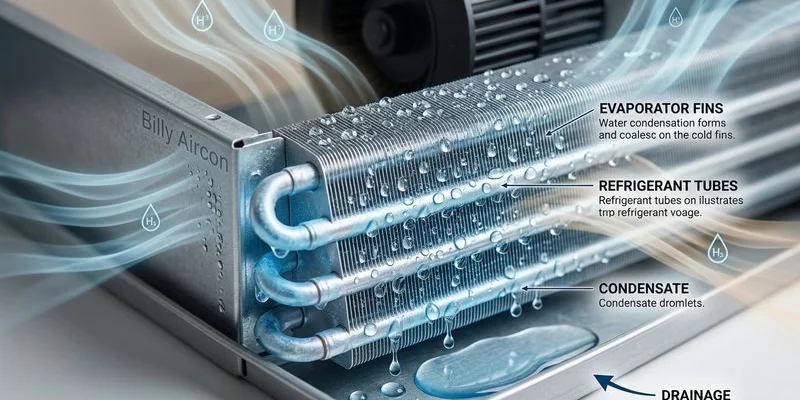
Every aircon removes humidity as a byproduct of cooling. We want to explain exactly how this mechanical process works inside your unit. Here is the step-by-step cycle:
- The indoor unit draws warm, humid room air across the cold evaporator coil.
- As the air passes over the cold coil, its temperature drops below the dew point.
- Moisture in the air condenses on the coil fins, just like water on a cold glass.
- The condensed water drips into the drain pan and flows out through the drain pipe.
- The now cooler, drier air is blown back into the room.
We regularly measure the output of a typical 12,000 BTU split-system aircon, like a standard Daikin or Mitsubishi unit. These standard units remove 1 to 3 litres of water per hour from the air during normal cooling operation. Our team considers that a significant amount of dehumidification happening automatically.
However, cooling mode focuses on lowering sensible heat, meaning temperature reduction is the priority rather than moisture removal. We always inform customers that dehumidification in this mode is a helpful side effect, not the primary goal. SP Group data shows that air-conditioning accounts for up to 24% of the average Singapore household electricity bill, making efficient usage crucial.
Using Dry Mode Effectively
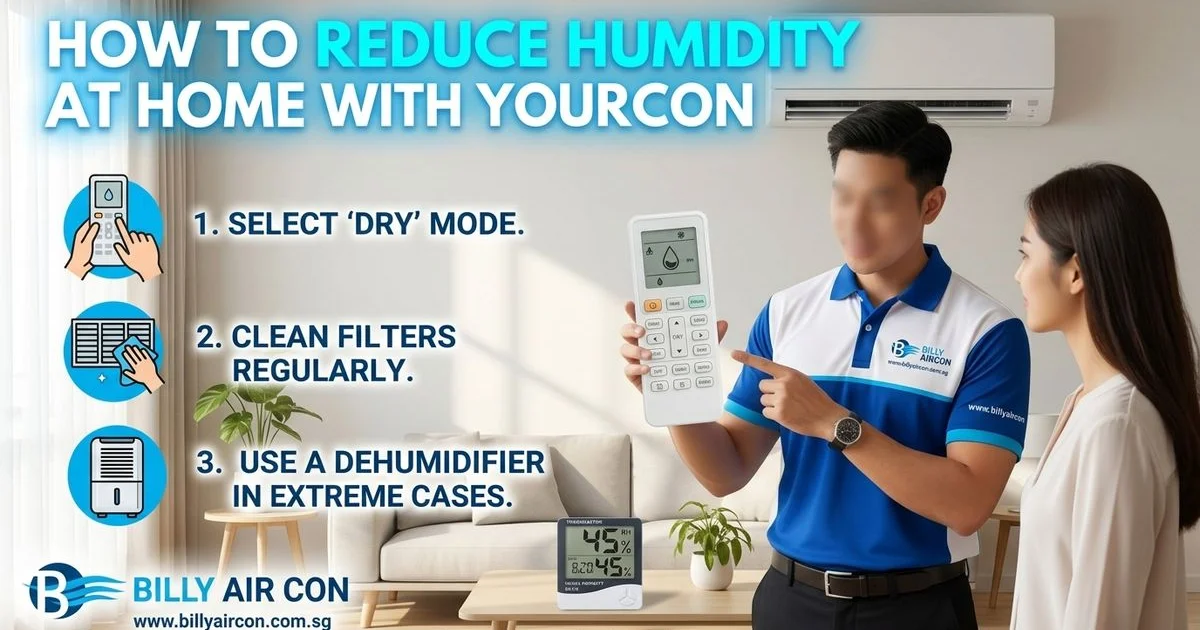
We highly recommend using the dry mode feature on your remote, usually represented by a water droplet icon. Dry mode is designed specifically for dedicated dehumidification.
How Dry Mode Works
We find that in dry mode, the aircon prioritises moisture removal over temperature reduction. The mechanics shift in several specific ways:
- The compressor cycles on and off in short intervals.
- The fan runs at low speed.
- Air passes over the cold coil slowly, maximising moisture extraction.
- The room temperature drops slightly, but not as aggressively as in cooling mode.
When to Use Dry Mode
Our experts suggest specific scenarios where this setting shines.
Ideal conditions for dry mode:
- The room feels humid and sticky, but the temperature is tolerable at 26 to 28°C.
- After rain when humidity spikes indoors.
- In rooms with indoor laundry drying.
- On cloudy, humid days when cooling is not the priority.
- During the inter-monsoon periods, like April to May or October to November, when humidity is high but temperatures are slightly lower.
There are also specific times when this setting is less effective.
Not ideal for dry mode:
- Hot afternoons when you need strong cooling for rooms over 30°C.
- When you want rapid temperature reduction.
- For overnight use, as sleep mode in cooling mode is generally better for sleeping comfort.
Dry Mode Energy Savings
SP Group guidelines highlight that optimising aircon usage is the best way to reduce household energy consumption. We calculate that dry mode uses approximately 30% to 50% less electricity than cooling mode because the compressor runs intermittently rather than continuously. If humidity, not heat, is your primary discomfort, switching to this setting saves meaningful money.
Dry Mode Limitations
We must point out that you cannot set a target humidity level on standard residential aircon units. The unit simply removes as much moisture as it can within its operating parameters. Our tests show the room will get somewhat cooler, typically 2 to 4°C below the current temperature, but you cannot control exactly how much. If you require a precise 55% humidity level, you will need a dedicated standalone machine like a Novita dehumidifier.
Optimal Settings for Humidity Control
We have determined the best configurations to maximize your system’s efficiency. Adjusting just a few buttons can drastically improve indoor air quality.
Temperature Setting
We recommend following SP Group’s advice to set your aircon to 25°C for the best balance of cooling and energy efficiency. Lower temperatures do extract more moisture because a colder coil creates more condensation. Our utility bill analyses show that the energy cost increases significantly for every degree below 24°C.
“Setting the air-conditioner temperature to 25°C or higher is one of the most effective ways to lower household electricity consumption in Singapore.”
Fan Speed
A lower fan speed equals much better dehumidification. We explain this by looking at “dwell time,” which means when air moves slowly across the evaporator coil, it has more contact time with the cold surface. This extended contact allows more moisture to condense out of the air. We advise reserving high fan speeds for situations when you need to drop the room temperature very quickly.
Swing Direction
Pointing the louvres slightly upward utilizes the Coanda effect for better distribution. We know that dry air from the aircon is denser and heavier than humid room air. Directing the dry airflow upward helps it mix with the humid air at ceiling level before descending. Our airflow tests confirm this creates a much more uniform dehumidification effect throughout the entire room.
Practical Tips to Reduce Indoor Humidity
Your aircon can only do so much on its own. We always teach our clients that these complementary measures make a massive difference.
1. Close Windows and Doors When the Aircon Runs
This sounds obvious, but many Singapore homes leave kitchen windows or bathroom doors open while the bedroom aircon runs. We constantly see systems working overtime because humid air constantly flows in to replace the treated air. Keep the cooled space sealed tightly to give the compressor a break.
2. Use the Kitchen Exhaust Fan
We strongly advise running the exhaust fan whenever you are boiling or steaming food. It vents cooking moisture directly outside rather than letting it spread through the flat. Our secondary recommendation is to open the kitchen window while closing doors to the rest of the flat if you lack an exhaust fan.
3. Ventilate the Bathroom After Showers
Run the bathroom exhaust fan for 15 to 20 minutes after showering. We suggest keeping the bathroom door closed so the heavy steam does not escape into the corridor and bedrooms.
4. Avoid Indoor Drying in Aircon Rooms
Drying clothes on an indoor rack in an air-conditioned room puts the unit in a battle it struggles to win. We already established that a load of laundry releases up to 3 litres of water directly into the air. If possible, dry clothes using alternative methods:
- In the naturally ventilated service yard.
- On traditional exterior bamboo poles.
- In a spare room with the windows wide open.
We tell clients that if they must dry clothes indoors, they should do it in a closed room with the dry mode running.
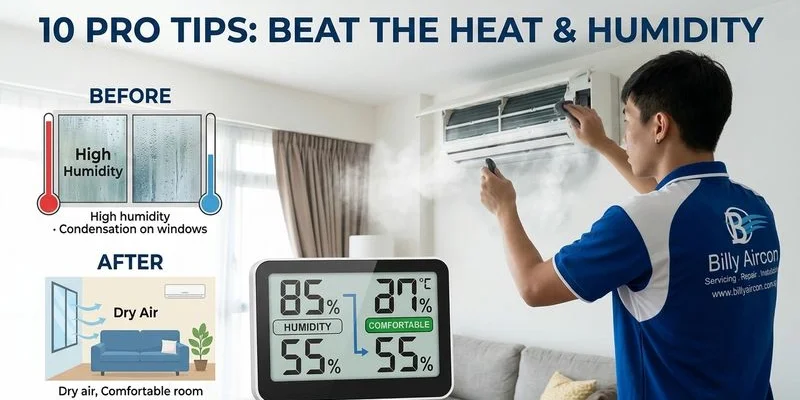
5. Use Dehumidifier Boxes in Enclosed Spaces
For wardrobes, shoe cabinets, and storage spaces where aircon air does not circulate, use disposable dehumidifier boxes like Thirsty Hippo or Farcent. We find these passive absorbers do an excellent job protecting leather shoes and designer bags from rapid mould growth. Replace them when the container is full of water, which can be as often as every two weeks in poorly ventilated spaces.
6. Fix Air Leaks
We often discover gaps under doors, around window frames, and at pipe penetrations during our maintenance visits. These tiny openings allow humid outdoor air to constantly seep into your cooled rooms. Applying these simple fixes blocks the moisture:
- Door sweeps or draft stoppers under bedroom doors.
- Weatherstrip tape around window frames.
- Foam or putty to seal gaps around aircon pipe penetrations.
7. Run the Aircon in Fan Mode After Cooling
When you turn off the unit, the wet evaporator coil starts warming up in the dark casing. We warn clients that this residual moisture can easily become a breeding ground for mould and bacteria. Running the system in fan-only mode for 15 to 20 minutes after cooling dries out the evaporator coil completely. We love that modern Mitsubishi and Daikin units now include an auto-clean or mould-guard function that performs this step automatically.
Signs Your Aircon Is Not Dehumidifying Properly
If you run the system and the room still feels sticky, something requires mechanical attention. We check for these specific issues during our troubleshooting visits.
Dirty Evaporator Coil
A coil coated in thick dust and grime has a drastically reduced surface area for condensation. We see this constantly, resulting in less moisture condensing out of the air while the room stays humid. Professional chemical cleaning restores the heat exchange performance immediately.
Refrigerant Level Too Low
We find that low refrigerant means the evaporator coil simply does not get cold enough to reach the dew point. Less condensation forms, and the system removes far less moisture from the environment. Specific signs include:
- The unit blowing cool rather than cold air.
- Ice forming on the copper pipes or evaporator coil.
- Hissing or bubbling noises from the indoor unit.
Our technicians check the gas pressure immediately when we spot these indicators.
Oversized Unit
An aircon that is too powerful for the room can actually dehumidify very poorly. We call this “short cycling,” where the compressor cools the air so fast that it shuts off before removing adequate moisture. The room reaches the set temperature quickly, but the air retains a heavy, clammy feeling.
Undersized Unit
We sometimes encounter units that are too small for the specific square footage of the room. These systems run continuously at maximum capacity but cannot keep up with the cooling demand. The unit removes some moisture, but it remains completely overwhelmed by the room’s total heat load.
Blocked Drain
If jelly-like biological growth blocks the pipe, the drain pan fills with standing water. We frequently have to clear these pans because that standing water re-evaporates, adding moisture back into the room. A properly draining system removes condensed water completely out to the bathroom or exterior pipe.
Ideal Indoor Humidity Levels
We reference the National Environment Agency (NEA) SS 554 standard for indoor air quality benchmarks. This framework outlines acceptable limits to ensure indoor environments remain safe and comfortable.
| Humidity Level | Comfort Level | Notes |
|---|---|---|
| Below 40% | Too dry | Rare in Singapore; causes dry skin, irritated throat |
| 40-50% | Ideal comfort | Difficult to achieve consistently in Singapore |
| 50-60% | Comfortable | Realistic target with aircon in Singapore; aligns with NEA guidelines |
| 60-70% | Slightly humid | Acceptable with good air circulation |
| Above 70% | Uncomfortable | Promotes mould growth, dust mites, musty smells |
We believe achieving 50% to 60% indoor humidity with your aircon running is a very realistic target. Getting below 50% typically requires a dedicated compressor-based dehumidifier running alongside your cooling system.
Humidity and Health
We know that excessive indoor moisture in Singapore goes beyond simple discomfort. It carries very real health implications for your family or employees.
Mould and Bacterial Growth
We closely follow indoor air quality studies, like recent research from Pico X Health, which shows mould spores germinate in just 12 to 24 hours when humidity exceeds 80%. Mould thrives anywhere above the 70% threshold. We have seen how these spores trigger serious allergies, asthma, and respiratory infections. Humid conditions on surfaces and inside dirty aircon units also promote rapid bacterial colonies.
Dust Mites and Heat Stress
We want to highlight a landmark study by the Singapore Immunology Network and the National University of Singapore regarding indoor allergens. Researchers found that approximately 80% of adults in Singapore with respiratory allergies are reacting specifically to house dust mites. We know these microscopic pests proliferate in warm, humid conditions. High humidity also reduces your body’s ability to cool itself through sweating, increasing the risk of heat exhaustion even at moderate indoor temperatures. We strongly advocate for managing indoor humidity to achieve better health outcomes, especially for children and the elderly.
In Singapore, your aircon absolutely does double duty as both a cooler and a dehumidifier. We encourage you to use dry mode when appropriate and keep the fan speed low for better moisture extraction. Complementing these settings with practical measures like using exhaust fans will drastically improve your indoor comfort.
We suggest booking a servicing appointment if your system seems to be struggling with humidity despite running consistently. Dirty coils, low refrigerant, or drainage issues all drastically reduce dehumidification effectiveness.
We invite you to explore our aircon servicing packages that keep your unit dehumidifying at peak performance. Check our servicing price list for transparent rates on all maintenance options.
Need help with humidity in your home? Learning how to reduce humidity at home with your aircon is the easiest way to improve indoor comfort. We are ready to assist; just WhatsApp Billy Aircon at +65 9187 4498 for expert advice and professional servicing across Singapore.