We know exactly how frustrating it is when your cooling system starts failing right in the middle of a sweltering afternoon. Spotting the 10 signs your aircon needs repair early is the best way to prevent a total disaster.
Small warning signs usually appear weeks before a complete breakdown occurs. Our team of 26 technicians at Billy Aircon, offering professional aircon servicing in Singapore since 2003, sees these exact patterns every single day.
Data from the National Environment Agency shows that air conditioning accounts for up to 40 percent of total household electricity consumption. Ignoring a struggling unit just burns through your monthly budget.
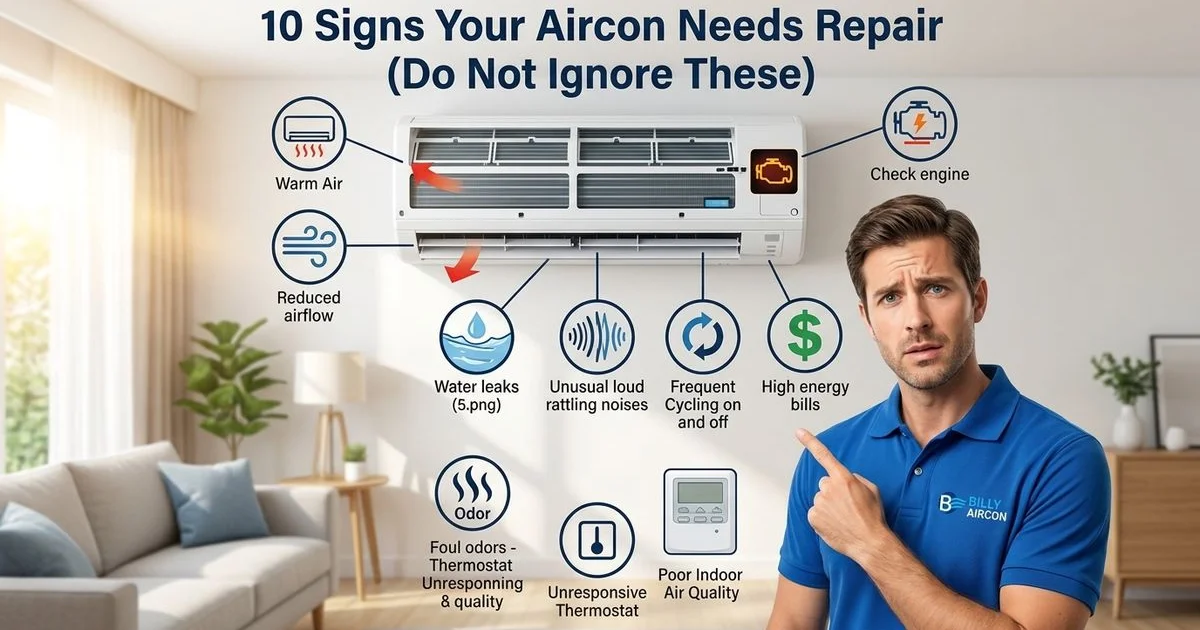
We will break down the ten clearest indicators of an impending breakdown, explain the underlying causes, and show you exactly how to respond.
1. Your Aircon Is Not Blowing Cold Air
We consider this the most obvious indicator that something has gone fundamentally wrong with your cooling cycle. Turning the temperature lower on your remote will absolutely not fix the underlying mechanical issue. The air coming out of the vents might feel warm or just slightly cool, which means the system is failing to remove heat from your room. Learn more about why your aircon is not cold and what causes this common problem.
Our technicians frequently trace this problem directly back to the type of refrigerant gas your system uses. Older units still rely on R410A gas, while modern 5-tick models mandated by the National Environment Agency use highly efficient R32 refrigerant.
A slow leak in either type of gas line drastically reduces the Cooling Seasonal Performance Factor (CSPF) of your machine. We always test the system pressure to see if a top-up or pipe repair is required.
Here are the most common culprits behind a lack of cold air:
- Low refrigerant (gas): This is the most frequent cause, usually stemming from a slow leak in the copper piping.
- Dirty evaporator coils: A thick layer of grime prevents the R32 or R410A gas from properly absorbing heat.
- Faulty compressor: The outdoor motor is struggling to pump refrigerant through the circuit.
- Blocked air filters: Restricted airflow stops warm room air from reaching the cooling coils.
We highly recommend avoiding DIY gas top-ups, as R32 operates under high pressure and requires certified handling. Running a starved compressor will eventually burn out the motor completely. This forces a replacement that costs anywhere from $600 to $1,500 in today’s market. Contact Billy Aircon to get your unit inspected by our experienced technicians.
2. Water Leaking from the Indoor Unit
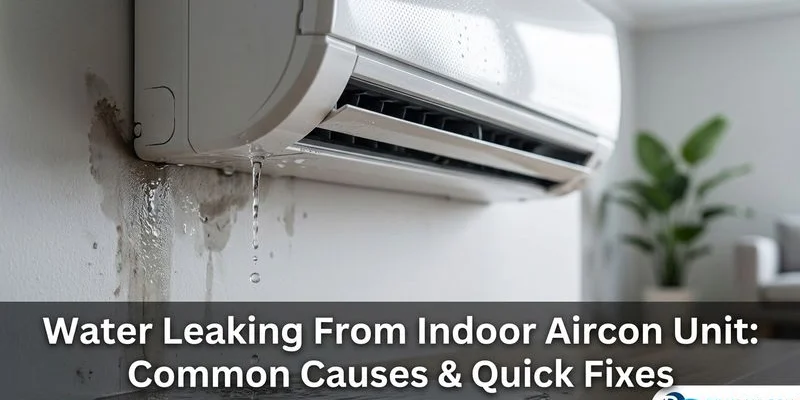
We see dripping indoor units almost daily, and this issue is a massive source of neighborly disputes in HDB flats and condominiums. Condensation naturally forms during the cooling process, but it is supposed to flow seamlessly out through a 13mm or 16mm drainage pipe. A puddle on your floor means that the internal system has failed completely.
Our teams frequently encounter blockages caused by a thick, jelly-like biofilm. Dust mixes with the high 84 percent average humidity in Singapore to create this slime, which eventually clogs the narrow drainage routes.
The Housing and Development Board has strict regulations stating that all condensation must discharge into a designated floor trap, never out the window. We receive calls from panicked homeowners facing complaints from their Town Council because their external compressor or indoor unit is dripping onto the property below.
Common causes for this messy problem include:
- Blocked drainage pipe: The condensate cannot flow out, causing the internal pan to overflow.
- Cracked or misaligned drainage pan: The plastic tray collecting condensation has sustained physical damage.
- Frozen evaporator coils: Ice forms rapidly on the coils and melts all at once, overwhelming the drainage tray.
- Improper installation: The unit lacks the necessary 1cm downward slope to allow gravity drainage.
We strongly advise you to turn off the power immediately to protect your walls, flooring, and electrical sockets. Water leaks also create the perfect damp environment for serious mould growth. Call Billy Aircon immediately if you notice water leaking from your unit.
3. Strange Noises Coming from the Unit
We expect top-tier modern air conditioners to operate at a whisper-quiet level. Market leaders like the Mitsubishi Electric Starmex or Daikin iSmileEco series generate incredibly low noise levels, typically sitting around 19 to 21 decibels in their quiet modes. A sudden racket from your machine is a massive red flag.
Our diagnostic process always begins by matching the specific sound to a failing mechanical component. A unit that sounds like a rattling washing machine usually has failing fan motor bearings that need immediate lubrication or replacement. Continuing to force a loud unit to run will invariably cause adjacent parts to snap or shatter under the intense vibration.
Pay close attention to these specific warning sounds:
- Rattling or vibrating: Loose mounting brackets, screws, or front casing panels.
- Grinding or scraping: The indoor fan motor bearings are completely wearing out.
- Buzzing or humming: A dangerous electrical arcing issue or a compressor struggling to start.
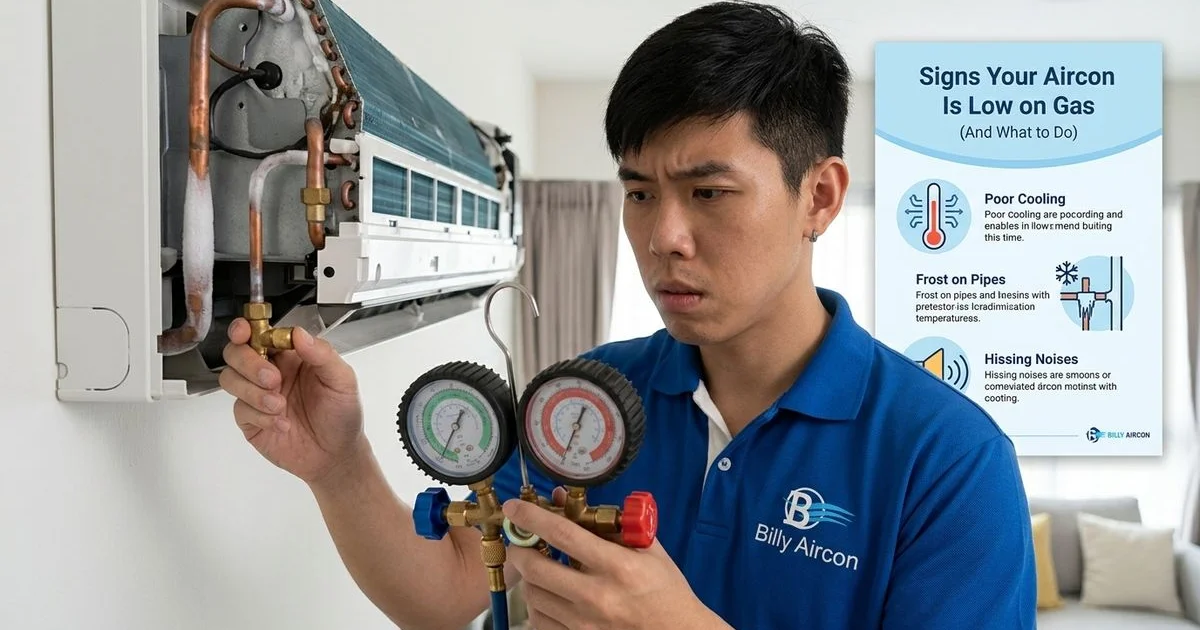
- Hissing or bubbling: High-pressure R32 or R410A refrigerant is leaking from the copper pipes.
- Clicking: A faulty thermostat or a failing relay on the control board.
We know that none of these mechanical sounds will magically resolve themselves over time. Ignoring a grinding fan will eventually destroy the blower wheel entirely. Get a professional diagnosis from Billy Aircon before the noise becomes a breakdown.
4. Bad Smell When You Turn On the Aircon
We treat foul odors coming from an air vent as a serious indoor air quality hazard rather than just a minor annoyance. Singapore’s persistent humidity keeps the internal evaporator coils and drainage pan constantly damp. This dark, wet environment acts as a perfect incubator for heavy microbial growth.
Our technicians regularly find colonies of Aspergillus and Penicillium mould thriving deep inside neglected systems. These specific fungal species produce volatile organic compounds that emit a distinct musty, sour smell every time the fan spins. You are effectively aerosolizing these dangerous mould spores into your sealed bedroom, which can trigger severe asthma attacks, chronic coughing, and skin irritation.
Other frequent causes of bad smells include:
- Dead insects or pests: Geckos and cockroaches often crawl inside the casing and die.
- Stagnant water: A partially blocked drainage pipe leaves foul water pooling in the internal tray.
- Burnt wiring: Overheating electrical components produce a sharp, acrid, plastic smell.
We recommend shutting off the power at the main breaker instantly if you detect any burning electrical odors. Standard surface cleaning will never remove deep-rooted fungal colonies hiding between the metal coil fins. Schedule a chemical wash with Billy Aircon to eliminate the source of the smell safely and completely.
5. The Aircon Keeps Turning Off by Itself
We refer to the frustrating cycle of a unit turning on for just a few minutes before shutting down as “short cycling.” This rapid on-and-off behavior prevents the room from ever reaching the desired temperature. It also completely destroys the system’s energy efficiency.
Our primary concern with short cycling is the massive strain it places on the outdoor compressor. The compressor requires a significant surge of electricity to start up, and forcing it to fire up constantly will overheat the electrical windings. An overheated compressor will trigger a safety shutdown to protect itself from bursting or catching fire.
The most frequent triggers for short cycling include:
- Overheating compressor: The main engine shuts down automatically to prevent catastrophic failure.
- Faulty thermostat: The temperature sensor sends wildly inaccurate readings to the main computer.
- Dirty filters restricting airflow: Trapped heat causes the internal coils to overheat.
- Low refrigerant: The system cannot maintain the necessary working pressure to sustain a cooling cycle.
- Electrical issues: A failing capacitor struggles to deliver the voltage required to keep the motor spinning.
We have seen countless homeowners destroy their machines by repeatedly forcing a short-cycling unit back on with the remote. A replacement compressor costs between $600 and $1,500 in Singapore today. Do not ignore short cycling, contact Billy Aircon for a thorough inspection.
6. Unusually High Electricity Bills
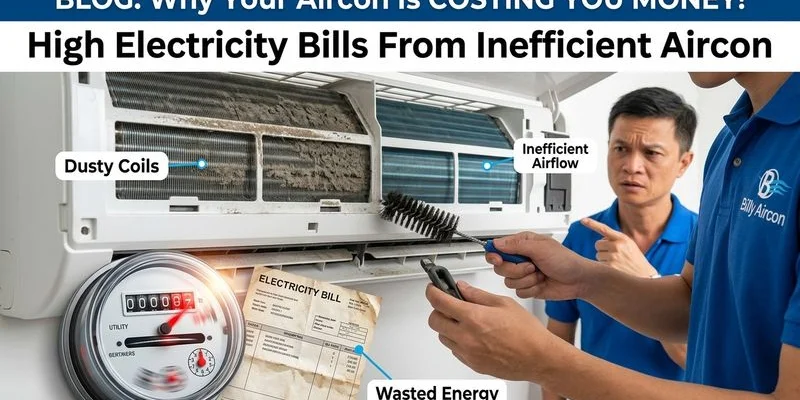
We always ask clients to check their SP Group utilities app if they suspect their cooling system is failing. The electricity tariff currently sits around 29 to 32 cents per kilowatt-hour, meaning an inefficient machine will cause a noticeable financial sting. If your usage patterns have not changed but your bill has skyrocketed, your cooling unit is almost certainly the culprit.
Our energy audits consistently prove that neglected machines have to run twice as long to achieve the same room temperature. Dust accumulation on the blower wheel and coils chokes the airflow, forcing the compressor into continuous overdrive. A modern 5-tick unit should cost roughly $15 to $30 a month to operate, but a struggling system can easily double that figure.
Common reasons for a massive spike in power consumption include:
- Dirty coils and filters: Reduced heat exchange efficiency forces much longer running times.
- Low refrigerant: The compressor runs continuously to compensate for the lack of cooling gas.
- Failing compressor: A damaged motor draws substantially more amperage than a healthy one.
- Old or worn-out unit: The mechanical efficiency has naturally degraded past the point of repair.
We urge homeowners to calculate the long-term cost of running a compromised system. Paying for preventative maintenance is far cheaper than funding a 30 percent spike in your monthly utility bill. Book a service with Billy Aircon to restore your unit’s efficiency.
7. Ice Forming on the Pipes or Coils
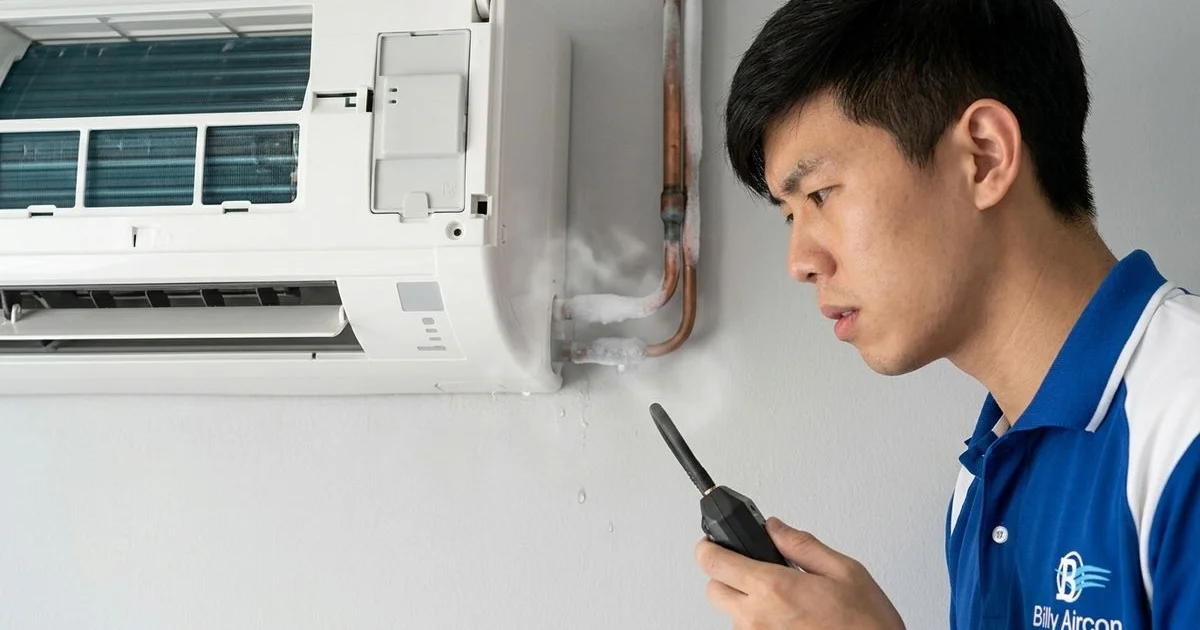
We consider visible frost or thick ice forming on your indoor coils or outdoor copper pipes to be a severe mechanical warning sign. Many people mistakenly think ice means the system is working exceptionally well and producing ultra-cold air. The reality is that the heat exchange process has completely broken down.
Our pressure tests usually reveal that a refrigerant leak is causing the internal temperature to plunge below the freezing point of water. The normal operating temperature of an evaporator coil should sit comfortably around 8 to 12 degrees Celsius below your room temperature. When it drops to zero, the natural condensation instantly freezes into a solid block of ice right on the metal fins.
Ice formation is typically caused by these specific failures:
- Low refrigerant levels: Reduced system pressure causes the remaining gas to become excessively cold.
- Restricted airflow: Blocked filters prevent warm room air from reaching and melting frost on the coils.
- Faulty expansion valve: The metering device fails to regulate the precise flow of refrigerant liquid.
- Fan motor failure: The blower wheel cannot push enough ambient air across the chilled fins.
We always warn clients that running an iced-up machine will cause liquid refrigerant to flow backward into the compressor, destroying it instantly. The ice also acts as a thick insulator, completely stopping any cold air from reaching your room. Turn off your aircon and call Billy Aircon if you notice ice formation.
8. The Remote Control or Thermostat Is Not Responding
We often receive frantic calls from users who are trapped in a freezing room because their remote control commands are completely ignored. If the displayed temperature on the remote does not match the actual climate in the room, the electronic communication has failed. Replacing the batteries is the obvious first step, but the issue usually runs deeper.
Our electronic diagnostic tools frequently pinpoint a failure in the Printed Circuit Board (PCB), which serves as the electronic brain of the machine. The PCB processes every command, and a replacement board in Singapore typically costs anywhere from $350 to $900, depending on the brand. Before assuming the worst, you can test the system using a smart home controller like a Sensibo to see if the internal infrared receiver is the actual culprit.
Communication breakdowns usually stem from:
- Faulty remote control: Dead batteries, a shattered screen, or a damaged infrared emitter bulb.
- Defective thermistor: The delicate temperature sensor wire inside the casing is providing false data.
- Control board (PCB) failure: A power surge has fried the main logic board.
- Wiring issues: Loose internal connections between the receiver module and the main processor.
We advise against slapping the remote or the wall unit in frustration, as this can dislodge delicate sensors. A quick electronic sweep by a professional will identify exactly which circuit has failed. Have your thermostat checked by Billy Aircon.
9. Weak Airflow from the Vents
We consider weak air pressure from the vents to be the most common complaint during the hazy months in Singapore. If you have the remote set to the highest fan speed but only feel a pathetic trickle of air, a physical blockage has formed inside. The machine is spinning at full power, but the air cannot escape the casing.
Our cleaning teams consistently find that a sticky biofilm is the root cause of this restricted output. Fine PM2.5 dust particles bypass standard nylon mesh filters, settling directly onto the wet blower wheel blades. This sludge hardens and alters the aerodynamic shape of the fan blades, reducing the Cubic Feet per Minute (CFM) output by up to 50 percent.
The usual suspects for restricted airflow include:
- Clogged air filters: A dense mat of dust blocks the primary intake vents.
- Blocked fan blower: Grime buildup in the cylindrical fan wheel stops it from catching and throwing air.
- Duct issues: For ducted commercial systems, a collapsed flex-duct or a massive dust blockage.
- Failing fan motor: The motor capacitor is dying, preventing the wheel from spinning at its rated RPM.
We solve this issue by applying industrial-grade chemical foaming agents that dissolve the hardened biofilm completely. A simple surface wipe is never enough to restore the original wind speed. Restore your airflow, contact Billy Aircon.
10. Frequent Need for Repairs
We always tell our clients that having a technician visit your home every three months for emergency fixes is completely abnormal. A well-maintained system from a reputable brand should run flawlessly for 10 to 15 years in a Singaporean household. If you are stuck on a constant repair treadmill, your equipment is sending a clear message.
Our technicians use a strict financial formula to advise clients on when to stop repairing and start replacing. If a single repair quotation exceeds 50 percent of the cost of a brand-new unit, throwing good money after bad is a mistake. Since the National Environment Agency mandated that all new multi-split systems must meet the 5-tick energy standard as of April 2025, upgrading often pays for itself through massive electricity savings.
Frequent breakdowns usually indicate:
- An ageing unit: The compressor and motor have reached the absolute end of their mechanical lifespan.
- Unresolved root causes: Previous technicians only patched symptoms instead of fixing the actual refrigerant leak.
- Poor quality repairs: Cheap, non-original replacement parts are failing under stress.
- Capacity mismatch: A small 9,000 BTU unit is burning itself out trying to cool a massive living room.
We provide transparent cost-benefit analyses to help you make the smartest financial decision. Upgrading to a modern R32 inverter system will immediately stop the cycle of endless repair bills. Discuss your options with Billy Aircon, we will give you an honest assessment of whether to repair or replace.
What to Do When You Notice These 10 Signs Your Aircon Needs Repair
We know that spotting a warning sign can cause a moment of panic, but immediate action prevents massive bills. Shutting down the power at the main breaker is the single best way to protect the delicate compressor from permanent damage.
Documenting the specific symptoms, like the exact location of a leak or the pitch of a noise, helps the technician arrive prepared.
Our standard protocol requires a full visual and pressure check before any cleaning begins. The local industry offers two main types of interventions, and knowing the difference protects you from overpaying.
General maintenance is preventative, while a chemical overhaul is a deep, restorative process.
Understanding Maintenance Options
We use the table below to help clients understand exactly what type of intervention their failing system requires.
| Service Type | Average Cost (Per Unit) | Best For | Action Performed |
|---|---|---|---|
| General Servicing | $60 to $80 | Minor airflow drops, routine 3-month care | Vacuuming filters, clearing drain pipe, surface wipe |
| Chemical Wash | $85 to $120 | Foul smells, visible mould, weak wind | Chemical spray on coils, flushing out biofilm |
| Chemical Overhaul | $150 to $250 | Severe jelly clogs, heavy icing, major leaks | Full dismantling, deep acid/alkaline bath of parts |
Follow this simple action plan when trouble strikes:
- Do not panic, most aircon issues are repairable if caught early.
- Turn off the unit if you notice ice formation, burning smells, or sudden water leaks.
- Note the symptoms, track exactly what is happening, when it started, and how often it occurs.
- Contact a qualified technician, avoid DIY repairs on electrical or refrigerant components.
- Get a proper diagnosis before agreeing to any major compressor replacements.
We constantly remind homeowners that early intervention is incredibly cost-effective. A standard $60 servicing today easily prevents a $1,000 compressor meltdown tomorrow.
Do Not Wait Until Your Aircon Stops Working
We cannot emphasize enough that mechanical components never heal themselves. Every single warning sign discussed in this guide will steadily worsen as the days pass.
Catching a blocked pipe or a struggling motor early saves you thousands of dollars and prevents miserable, sweaty nights.
Our decades of experience prove that proactive maintenance extends the lifespan of your cooling investment by years. You deserve to relax in a perfectly chilled room without worrying about a sudden breakdown.
If you have noticed any of these 10 signs your aircon needs repair, WhatsApp Billy Aircon today.
We ensure that our team of experienced technicians will diagnose the problem and provide a transparent quote before any work begins. There are absolutely no hidden charges and no unnecessary upselling.
You will receive honest, professional aircon repair services anywhere across Singapore.