What Is Aircon Gas Top Up?
Your aircon does not cool the air by magic. It uses a chemical substance called refrigerant — commonly referred to as “gas” in Singapore — to absorb heat from indoor air and release it outside. This refrigerant circulates through a closed loop of copper piping between the indoor evaporator coil and the outdoor condenser unit. When refrigerant levels drop below the optimal amount, your aircon loses its ability to cool effectively.
An aircon gas top up involves a licensed technician adding the correct type and amount of refrigerant to your system, restoring it to the manufacturer’s specified charge level. This is one of the most common fixes for an aircon that is not blowing cold air.
It is important to understand that a properly installed and sealed aircon system should not lose refrigerant. If your aircon needs frequent gas top ups, it means there is a leak somewhere in the system that needs to be found and repaired. Simply topping up the gas without fixing the leak is like filling a bucket with a hole — the refrigerant will leak out again, and you will be back to the same problem within weeks or months.
At Billy Aircon, your trusted aircon servicing specialist in Singapore, we always check for leaks before topping up refrigerant. If a leak is detected, we inform you of the location, severity, and repair cost so you can make an informed decision.
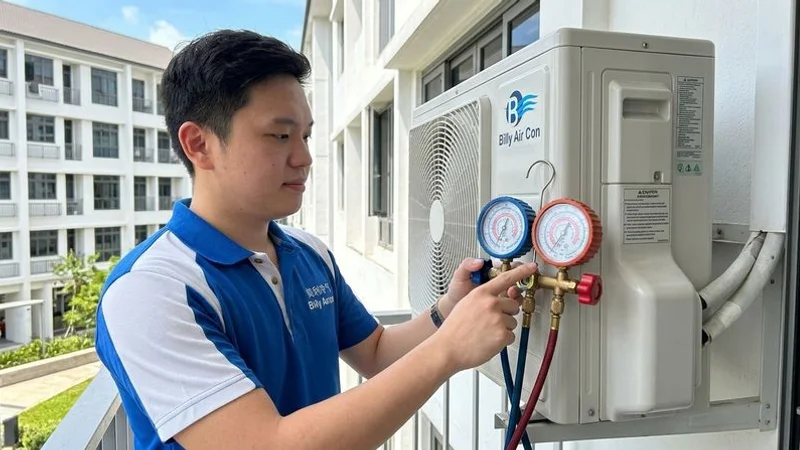
Gas Top Up Pricing by Refrigerant Type
Different aircon systems use different types of refrigerant. The type of gas your aircon uses depends on the brand, model, and when it was manufactured. Using the wrong type of refrigerant will damage your system, so it is critical that only the correct gas is used.
R22 (Freon) — $50 to $80
R22 is the older generation refrigerant that was standard in aircon systems manufactured before 2015. It is being phased out globally due to its ozone-depleting properties, but many older aircon units in Singapore still run on R22.
Key points about R22:
- Used in older aircon models (typically manufactured before 2010 to 2015)
- Being phased out worldwide under the Montreal Protocol
- Supply is becoming scarcer, which may increase costs in coming years
- Cannot be mixed with R410A or R32 — they are not interchangeable
- If your R22 system needs replacement, the new system will use R410A or R32
Pricing factors: The cost depends on the amount of refrigerant needed. A small top up to bring levels back to optimal may cost $50, while a system that has lost a significant amount may cost up to $80 including the leak detection process.
R410A — $60 to $150
R410A is the most common refrigerant used in residential aircon systems sold in Singapore today. It replaced R22 as the industry standard because it does not deplete the ozone layer and offers better energy efficiency.
Key points about R410A:
- Standard refrigerant for most modern aircon systems (2010 onwards)
- Does not deplete the ozone layer
- Operates at higher pressures than R22, requiring different equipment
- More energy efficient than R22
- Widely available and used by all major brands including Daikin, Mitsubishi, Panasonic, and LG
Pricing factors: R410A systems operate at higher pressure, and the gas itself is more expensive than R22. The amount needed and the source of any leak determine the final cost. A straightforward top up starts from $60, while larger refills after significant gas loss can reach $150.
R32 — $80 to $200
R32 is the newest generation refrigerant, increasingly adopted by leading brands for their latest models. It has a significantly lower global warming potential compared to R410A and offers improved energy efficiency.
Key points about R32:
- Used in the newest aircon models (2018 onwards)
- Lower global warming potential than R410A
- Higher energy efficiency
- Mildly flammable — must be handled by licensed professionals
- Used by Daikin, Panasonic, and other brands in their latest product lines
Pricing factors: R32 is more expensive than both R22 and R410A, and its mildly flammable classification requires additional safety precautions during handling. Top up costs range from $80 for a minor refill to $200 for a major recharge.
Signs Your Aircon Needs a Gas Top Up
Recognising the symptoms of low refrigerant early allows you to address the issue before it leads to more serious and expensive problems. Here are the telltale signs:
Reduced cooling performance — This is the most obvious sign. Your aircon is running, but the room does not get as cold as it used to. You find yourself lowering the temperature setting further and further, but the air blowing out of the unit still feels lukewarm. Low refrigerant means the system cannot absorb enough heat from the room.
Aircon runs continuously without cycling off — A properly charged aircon system cools the room to the set temperature and then cycles off until the temperature rises again. With low refrigerant, the system cannot reach the target temperature and runs continuously, wasting electricity and putting strain on the compressor.
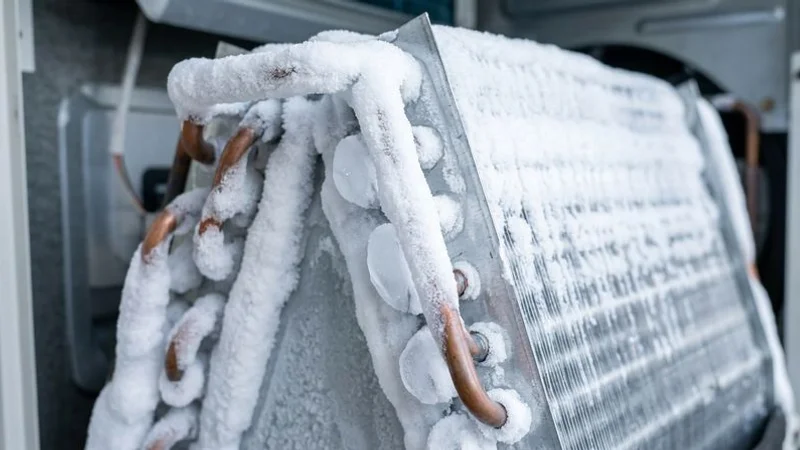
Ice formation on the evaporator coil — This may seem counterintuitive, but low refrigerant can cause ice to form on the evaporator coil. When refrigerant pressure drops too low, the coil temperature drops below freezing, causing moisture in the air to freeze on the coil surface. You might notice ice on the copper pipes or water leaking from the unit as the ice melts.
Hissing or bubbling sounds — If you hear unusual hissing or bubbling sounds from the indoor or outdoor unit, it could indicate a refrigerant leak. The sound is caused by gas escaping through a crack or hole in the piping or coil.
Higher electricity bills — An aircon with low refrigerant runs longer and works harder to cool the space, consuming more electricity. If your electricity bill has increased noticeably without a change in usage habits, low refrigerant could be the cause.
Warm air from one unit in a multi-split system — In multi-split systems where one outdoor unit serves multiple indoor units, low refrigerant may cause one indoor unit to blow warm air while others still cool adequately. This indicates the system does not have enough gas to serve all connected units at full capacity.
Why Refrigerant Leaks Happen
Understanding why your aircon loses gas helps you prevent future occurrences and decide whether repair or replacement makes more sense.
Vibration damage to pipe joints — Over time, the vibration from the compressor can loosen flared connections at pipe joints. This is one of the most common causes of slow refrigerant leaks. The leak may be so gradual that it takes months before you notice reduced cooling.
Corrosion of copper piping — Singapore’s humid, salty air (especially near coastal areas) can corrode copper piping over many years. Pinholes develop in corroded sections, allowing gas to escape slowly.
Poor initial installation — Improper flaring of pipe connections, incorrect brazing, or insufficient tightening during installation can result in leaks that may not become apparent until months or years later. This is why professional installation by experienced technicians is so important.
Physical damage — Accidental impact to the outdoor condenser unit or piping — from renovation work, falling objects, or even pest activity — can damage pipes and cause leaks.
Age-related wear — Like any mechanical system, aircon components degrade over time. Rubber seals, valve stems, and connection points all have finite lifespans. Systems older than 8 to 10 years are more prone to refrigerant leaks.
Our Gas Top Up Process
Step 1 — Diagnosis
Before adding any gas, our technician tests the system’s refrigerant pressure using professional gauges. This tells us exactly how much gas has been lost and whether a top up will bring the system back to optimal performance.
Step 2 — Leak Detection
We inspect the system for leaks using electronic leak detectors and visual inspection of all connections, valves, and coil surfaces. If a leak is found, we identify its location, assess the severity, and provide a repair quotation. Fixing the leak before topping up ensures the new gas does not simply escape again.
Step 3 — Refrigerant Identification
We verify the type of refrigerant your system uses. This is critical because mixing different refrigerant types will damage your compressor and void any remaining warranty. Our technicians check the data plate on the outdoor unit and confirm the gas type before proceeding.
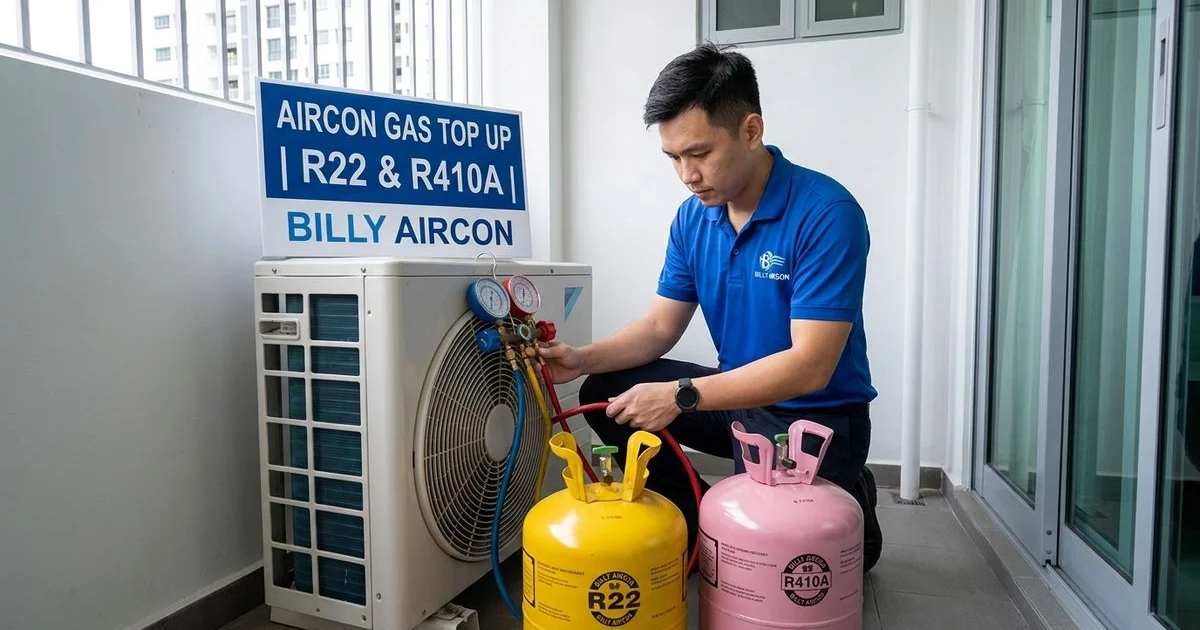
Step 4 — Gas Top Up
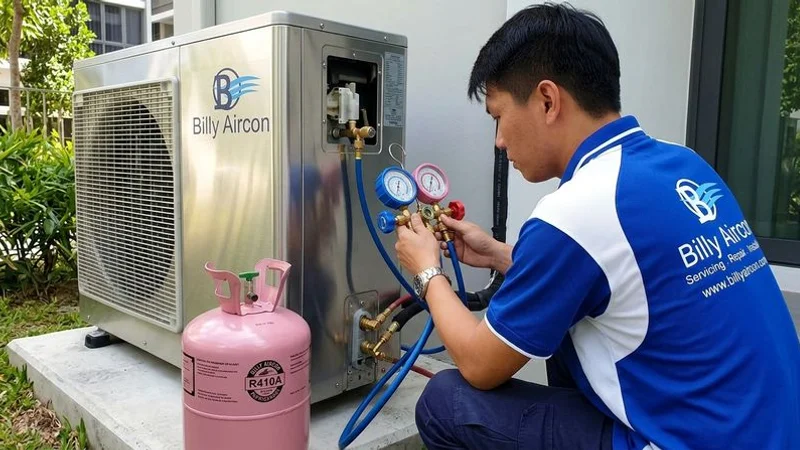
Using calibrated equipment, we add the precise amount of refrigerant needed to bring the system to the manufacturer’s specified charge level. Too little gas means inadequate cooling, while too much gas can damage the compressor and reduce efficiency. Precision matters.
Step 5 — Performance Test
After topping up, we run the aircon for at least 10 minutes and measure the supply air temperature, return air temperature, and refrigerant pressures. This confirms the system is operating correctly and cooling at its rated capacity.
Licensed Refrigerant Handling
In Singapore, refrigerant handling is regulated under the Environmental Protection and Management Act. Refrigerants are controlled substances that must be handled, stored, and disposed of by trained and licensed professionals. Improper handling poses environmental risks and can be dangerous.
All Billy Aircon technicians who perform gas top ups are trained and licensed for refrigerant handling. We use properly calibrated equipment, follow safe handling procedures, and ensure no refrigerant is vented into the atmosphere. Used or recovered refrigerant is disposed of through approved channels.
This is another reason why DIY gas top ups are not just inadvisable but potentially illegal. Purchasing refrigerant without proper licensing is restricted, and incorrect handling can result in frostbite, chemical burns, or environmental damage.
Frequently Asked Questions
How do I know which refrigerant my aircon uses? Check the data plate on the outdoor condenser unit. It will list the refrigerant type (R22, R410A, or R32). If you cannot find it, tell us your aircon brand and model number, and we can identify the correct refrigerant.
How often does aircon gas need topping up? A properly sealed system should never need a top up. If your aircon needs gas, it means there is a leak. After our technician fixes the leak and tops up the gas, you should not need another top up for the remaining life of the system.
Can I top up the gas myself? No. Refrigerant handling requires licensed professionals with proper equipment. DIY attempts can damage your system, void the warranty, and pose safety risks. Refrigerant under pressure can cause frostbite on contact with skin.
Why is R32 more expensive? R32 is a newer generation refrigerant with better environmental properties and higher energy efficiency. It is mildly flammable, requiring additional safety measures and specialised equipment during handling. These factors contribute to the higher cost.
My aircon is old and uses R22. Should I top up or replace? If your R22 system is more than 10 years old and needs a gas top up, we generally recommend considering a replacement. R22 is being phased out, making future top ups increasingly expensive. A new R410A or R32 system will be more energy efficient, more environmentally friendly, and more cost-effective in the long run.
How long does a gas top up take? The gas top up itself takes about 20 to 30 minutes per unit, including pressure testing and performance verification. If a leak needs to be repaired first, the total time depends on the leak location and severity.
Book Your Aircon Gas Top Up
If your aircon is not cooling as well as it should, low refrigerant gas is one of the most common causes. Our technicians will diagnose the issue, check for leaks, and restore your system to full cooling performance.
WhatsApp us at +65 9456 5942 to schedule a gas top up. We carry R22, R410A, and R32 refrigerant for all major aircon brands. Same-day service available for morning bookings. Serving all areas across Singapore.